

You know that low hum that shows up in a brand new building about three months after handover? The tenant on the fourth floor calls the facilities manager convinced there’s a machine running inside their bedroom wall. There isn’t. What they’re actually hearing is a fan coil unit two floors up, humming straight through a rigid hanger, into the ductwork, into the slab, and out through their ceiling like the whole building is one giant speaker cone.
And it’s an incredibly common problem. Suspended mechanical equipment, whether that’s ductwork, pipework, or a small fan unit, has to hang from something. If that something is a plain steel rod bolted straight to the structure, every vibration the equipment produces has a direct, uninterrupted path into the building. No gap, no cushion, nothing to break the chain. That’s where rubber hangers come in, and honestly, they’re one of the cheapest fixes in the entire mechanical spec sheet for a problem that costs a fortune to solve after the ceiling’s closed up.
Why Suspended Equipment Turns Into a Speaker System
Vibration doesn’t need much of a path to travel. Metal is an excellent conductor of mechanical energy, so when a fan, pump, or piece of ductwork is bolted directly to a steel bracket that’s fixed to a concrete slab, you’ve basically built a highway for noise. The vibration rides the rod, hits the structure, and radiates outward through walls and ceilings that are nowhere near the actual source.
This is called structure borne noise, and it’s sneaky because it doesn’t behave like airborne sound. You can’t block it with insulation batts or a thicker wall. It travels through solid material, and by the time it reaches an occupied room, it’s often been amplified by resonance in the slab or duct run. Acoustic consultants deal with this complaint constantly on hotel, hospital, and residential projects, and by the time someone’s filed a noise complaint, the fix usually means opening up a finished ceiling. That’s an expensive lesson to learn on site.
What a Rubber Hanger Actually Does
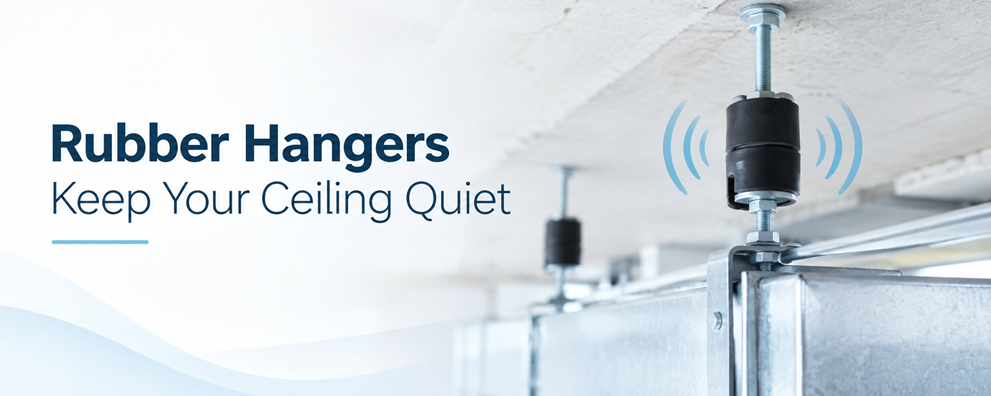
A rubber hanger sits inside the hanging assembly, between the structural rod and the equipment or duct it’s supporting. Instead of a rigid metal to metal connection, you’ve got a molded elastomer insert doing the job of absorbing that vibration energy before it ever reaches the building.
Vibro Limited’s VCHN Vibro Hanger Neoprene is a good example of how this works in practice. It uses a colour coded elastomer insert operating in shear, paired with a steel load washer, assembled into a precision formed steel bracket. The shear loaded configuration matters more than it sounds. Running the elastomer in shear rather than compression lets it handle a bigger deflection range before fatigue sets in, which means it keeps isolating vibration consistently for years instead of degrading after a couple of seasons of continuous HVAC cycling.
For lighter duty applications where there isn’t room for a full bracket, Vibro also makes compact hanger elements that do a similar job in a smaller footprint, ideal for tight ceiling voids where every centimetre of clearance is fought over between the electrician, the fire sprinkler contractor, and the HVAC guy.
Where They Actually Get Used
Rubber hangers show up wherever something suspended and vibrating needs to be kept quiet. That covers a lot of ground on a typical commercial or residential job:
- Ductwork runs above suspended ceilings in hotels and apartment towers
- Piping networks carrying chilled or hot water through plant rooms and risers
- Small fan coil units tucked into ceiling voids near bedrooms and offices
- Auxiliary suspended equipment like small pumps or valve assemblies
The load capacity matters a lot here, and it’s worth getting the sizing right rather than guessing. Vibro’s rubber hanger range covers deflection ratings starting from 1 inch (25mm), with load capacities running from a few kilograms for light fan coil brackets up to well over a tonne for heavier spring assisted hangers on larger ductwork runs. Undersize the hanger and you get a mount that bottoms out under load, which honestly performs worse than no isolation at all because it can introduce a rattle.
The Market Is Only Getting More Demanding
This isn’t a niche concern anymore. The global building vibration isolation market was valued at roughly USD 2.49 billion in 2024 and is on track to reach around USD 4.21 billion by 2033, growing at a compound annual rate near 6%. Europe, including the UK, is called out specifically as a region where stringent building regulations and the protection of existing structures are pushing designers toward better isolation as standard, not as an afterthought.
| Driver | What it means for hanger specification |
|---|---|
| High rise and dense urban construction | More suspended plant, more shared structure, less tolerance for noise transfer between floors |
| Stricter acoustic building regulations | Sound testing at handover means isolation has to actually perform, not just look right on paper |
| Renovation of existing buildings | Older structures transmit vibration more readily, so retrofit hanger specs often need tighter tolerances |
| Rising occupant expectations | Buyers and tenants notice mechanical noise faster than almost any other defect |
None of that is going away. If anything, the gap between “we installed hangers” and “we installed the correctly rated hangers” is going to matter more as sound testing becomes a routine part of project handover rather than something only done when a complaint forces the issue.
Getting the Selection Right the First Time
The mistake we see most often isn’t skipping rubber hangers altogether. It’s specifying a single hanger type across an entire project regardless of what’s actually hanging from it. A small fan coil unit and a large ductwork run generating serious vibration don’t belong on the same hanger spec. Match the deflection rating and load capacity to the actual equipment weight and vibration frequency, check the colour coded insert against the manufacturer’s load chart, and leave enough clearance in the ceiling void for the hanger to move through its full deflection range without fouling on cabling or ductwork.
If you’re speccing a project right now, browse the full Vibro Hanger range and match load ratings to your equipment schedule before the ceiling grid goes up, not after. And if you want a second opinion on sizing before you order, our team is genuinely happy to look over your equipment schedule, just get in touch.
The takeaway is simple. Rubber hangers are cheap relative to the cost of reopening a finished ceiling, but only if they’re sized correctly the first time. So here’s the question worth asking on your next project: has anyone actually checked the load rating on your hangers against the equipment schedule, or is everyone just assuming the last spec still applies? Drop a comment, we’d genuinely like to know how teams are handling this on site right now.


