

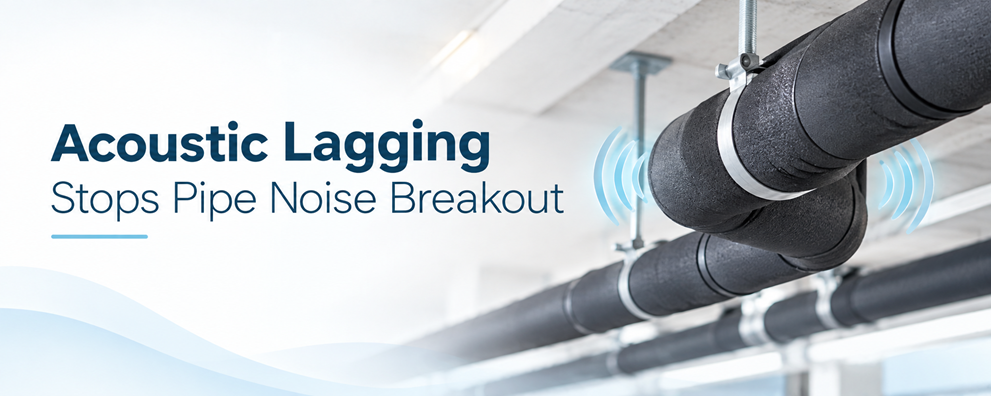
Ever stood in a hotel corridor and heard someone flush a toilet three rooms down, clear as day, through what’s supposed to be a soundproofed riser? Or sat in a downstairs bedroom listening to water gurgle through a soil pipe like it’s running past your pillow? That’s noise breakout, and it’s one of the most common complaints acoustic consultants field on residential and hospitality projects. And the frustrating part is, the fix usually isn’t complicated. It’s often just a missing layer of acoustic lagging around the pipe.
Bare pipework and ductwork radiate sound the same way a drum skin does. Water hammer, flow turbulence, and mechanical vibration all set the pipe wall into motion, and that motion pushes sound straight into the surrounding riser cupboard, ceiling void, or wall cavity. Once it’s in there, it travels to wherever the path of least resistance leads, which is usually the nearest bedroom.
The Noise That Won’t Stay Where It Started
Plant rooms, risers, and ductwork runs are meant to be sealed away from occupied space. But sound doesn’t respect that boundary unless something is actually stopping it. A standard pipe wall, even a thick one, offers surprisingly little resistance to airborne noise breakout on its own. Add insulation for thermal reasons and you might slow heat loss, but thermal insulation and acoustic insulation are not the same job, even though people mix them up constantly on site.
This gets worse the higher the building goes. Taller residential towers and hotels have longer riser runs, more branch connections, and more opportunities for noise to escape into a shaft that runs past dozens of bedrooms on its way up. One noisy valve on floor three can end up being heard on floor nine if the riser isn’t properly treated.
What Acoustic Lagging Actually Is
Acoustic lagging is a wrap applied directly around pipework or ductwork to stop that sound breakout at the source. Vibro Limited’s VIBRO LAG Acoustic Lagging is built from a mass loaded, limp polymer barrier bonded to a resilient decoupling layer of fire resistant fibreglass. Those two materials are doing two different jobs at once. The mass loaded barrier is heavy and limp on purpose, so it reflects sound energy rather than resonating with it. The fibreglass layer behind it absorbs what the barrier doesn’t reflect and decouples the whole assembly from direct contact with the pipe wall, which stops the lagging itself from becoming a new source of vibration transfer.
For sealing and securing the wrap, there’s also VIBROLAG Tape, an aluminium foil tape with a three way foil, scrim, and kraft backing, held together with a synthetic rubber resin adhesive. It sounds like a small detail, but a poorly sealed lagging joint is a gap sound will find every single time. Acoustic performance is only as good as the weakest seam.
Where This Gets Specified in Real Projects
Acoustic lagging isn’t limited to one type of building. It shows up wherever pipework or ductwork passes near occupied space:
- Soil and waste stacks running behind bedroom and bathroom walls
- Chilled water and heating pipework in ceiling voids above meeting rooms
- Ductwork in hospitals where noise criteria are unusually strict for patient comfort
- Plant room pipework where mechanical noise needs to stay contained before it reaches a shared wall
In the UK, this kind of treatment is increasingly tied directly to compliance rather than being a nice to have. Approved Document E, the building regulation governing resistance to the passage of sound, sets out airborne and impact sound insulation targets for dwellings, schools, and shared residential buildings, and most residential developments now require pre completion sound testing to prove the finished building actually meets those targets. Guidance published in 2026 has also put more emphasis on flanking noise, meaning the sideways paths sound takes around the main separating structure rather than straight through it. An untreated pipe run is exactly the kind of flanking path that can undo an otherwise well designed wall or floor.
The Numbers Behind the Push for Better Acoustic Treatment
The wider market backs up what’s happening on site. Vibration and acoustic isolation materials are forecast to grow at roughly 4.8% annually through 2035, driven partly by stricter noise exposure standards and partly by denser construction that puts more people closer to more mechanical services.
| Factor | Why it pushes lagging up the spec sheet |
|---|---|
| Sound testing at handover | Pre completion testing under Approved Document E means noise breakout gets caught before occupation, not after |
| Taller, denser buildings | Longer riser runs and more shared walls mean more chances for pipe noise to travel |
| Healthcare and hospitality standards | Patient and guest noise criteria are typically stricter than standard residential targets |
| Renovation and retrofit work | Older buildings often have zero acoustic treatment on existing pipework, making lagging a fast retrofit win |
That last point is worth sitting with for a second. A lot of noise complaints in older buildings aren’t a structural defect at all, they’re just a pipe that was never lagged in the first place. Wrapping it after the fact is far cheaper than most people assume.
Getting Lagging Right on Site
The biggest failure point isn’t the material, it’s the installation. Gaps at joints, lagging that stops short at a bracket or support, and seams sealed with the wrong tape all create weak points that let noise leak straight through. Treat every penetration, every bracket, and every joint with the same care as the run itself, and make sure the lagging wraps fully around the pipe rather than just covering the top and sides that are easiest to reach.
If you’re speccing a riser or plant room right now, take a look at the full Vibro Lag range before the ceiling closes up, because retrofitting lagging into a finished void costs multiples of what it costs during first fix. And if you’re not sure which thickness or barrier weight suits your noise criteria, our technical team can talk it through, just reach out here.
So here’s the actionable bit. Before your next riser or plant room gets closed in, walk the run and check every joint gets fully wrapped and sealed, not just the easy sections. It takes an extra hour on site and saves a very awkward conversation after handover. Has your team ever had to reopen a finished ceiling because of pipe noise breakout? Tell us what happened in the comments, we’re curious how common this actually is out there.


