

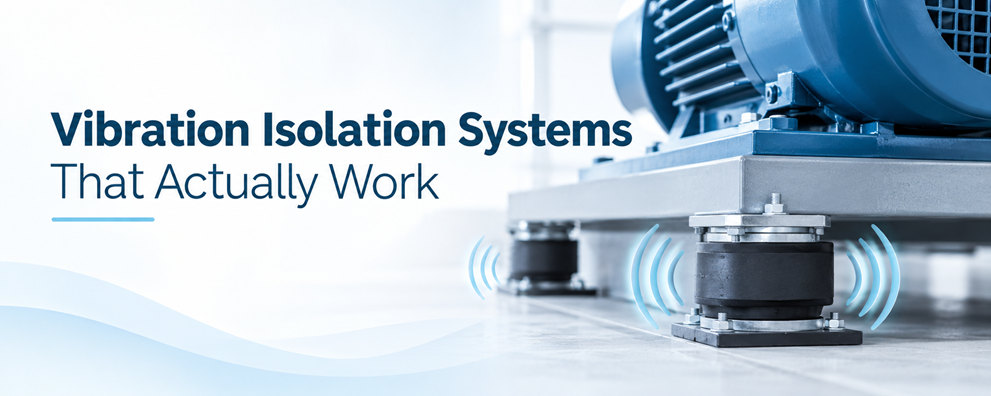
Ask any facilities manager who inherited a badly isolated chiller plant what the fix cost, and the answer is almost always higher than they expected. Not because the equipment failed. Because the whole building started humming, tenants started complaining, and by the time anyone traced it back to the plant room, the isolators were already three years old and buried under pipework nobody wanted to disturb. Retrofitting a vibration isolation system after the fact is one of the most expensive corrections in mechanical engineering, and it happens constantly because the original spec treated isolation as one product instead of a system.
That distinction matters more than it sounds. A single spring mount under a compressor doesn’t isolate anything on its own if the base it’s sitting on flexes, or if the pipework connected to that compressor is rigidly clamped somewhere else and carrying vibration straight past the isolator. Vibration isolation only works when every connected element, the mount, the base, the pipe connections, and the structure, is considered together.
When Isolation Fails, Everyone Notices
Mechanical equipment generates vibration whether it’s a rooftop chiller, a basement pump, or a rotating fan. Left unisolated, that vibration transfers into whatever the equipment sits on or hangs from, and from there it spreads through the structure. In a dense building, that means it doesn’t stay confined to the plant room. It travels through slabs, up risers, and into occupied space three or four floors away, often arriving as a low frequency hum that’s hard to pinpoint and even harder to explain to a frustrated tenant.
And the tricky part is that a poorly isolated system doesn’t always fail immediately. It can run fine for a season or two before fatigue in an undersized mount, or a rigid connection somewhere in the chain, starts letting more vibration through than it should. By then, the problem reads as a mystery rather than what it actually is, a sizing or installation shortfall from day one.
What a Real System Actually Includes
Vibration isolation isn’t one product, it’s a chain of compatible components matched to a specific piece of equipment. Vibro Limited’s range covers the full chain:
- Spring isolators like the VRSIF free standing spring isolator, built for high deflection applications where large diameter, laterally stable steel coils absorb serious vibration from heavier mechanical equipment
- Neoprene mounts such as the VRMT range, precision moulded with encapsulated steel inserts, suited to lighter equipment where full spring assemblies aren’t necessary
- Elastomeric pads for grade level or non bolted installations, where mechanical anchoring isn’t practical but vibration still needs controlling
- Inertia bases, which add mass and stiffness beneath heavier rotating equipment so the isolators underneath have a stable, non flexing platform to work from
Skip any one of these and you’ve got a weak link. A spring isolator sitting on a base that flexes under load will still transmit vibration, just through a different path than the one you designed for.
Matching the Isolator Type to the Equipment
This is where most sizing mistakes happen. Spring isolators generally suit heavier equipment and lower operating speeds because they achieve a lower natural frequency, which is what actually determines isolation efficiency. Neoprene and elastomeric mounts work well for lighter, higher speed equipment where the deflection needed is smaller. Get this backwards, put a lightweight neoprene pad under equipment that really needs a spring isolator’s deflection range, and the isolator will bottom out under load, transmitting vibration almost as if it weren’t there at all.
The rule of thumb worth remembering is that isolation efficiency depends on the ratio between the equipment’s operating frequency and the isolator’s natural frequency. The bigger that gap, the better the isolation. That’s a calculation, not a guess, and it’s worth having a technical conversation about before ordering rather than after installation.
The Market Is Investing Heavily in Getting This Right
This isn’t a small corner of the construction industry anymore. The global building vibration isolation market was valued at roughly USD 2.49 billion in 2024 and is projected to reach around USD 4.21 billion by 2033. Growth is being pushed by taller buildings, denser urban construction, and a genuine shift toward treating occupant comfort as a design requirement rather than an afterthought.
| Segment | 2024/2025 value | Forecast | Primary driver |
|---|---|---|---|
| Building vibration isolation | USD 2.49 billion (2024) | USD 4.21 billion by 2033 | Urbanisation, high rise construction, occupant comfort |
| Active vibration isolation systems | USD 1.5 billion (2025) | USD 2.8 billion by 2034 | Precision manufacturing, healthcare imaging, semiconductor facilities |
| Vibration isolator pads | USD 378 million (2025) | USD 648 million by 2033 | HVAC retrofit demand, industrial machinery upgrades |
Europe, including the UK, gets called out specifically in market research for its stringent building regulations and the growing need to protect historic structures during renovation, where added vibration from nearby construction or retrofitted plant can be a genuine structural concern, not just a comfort issue.
The Sizing Mistake That Costs the Most
The single biggest mistake we see is specifying isolators by equipment type alone rather than by actual operating weight, speed, and location within the structure. Two identical looking chillers on two different floors of the same building can need different isolator specs if one sits over a long span slab and the other sits over a short, stiff one. Structural stiffness changes the isolation requirement, and skipping that step is how a technically correct isolator ends up performing poorly in the field.
If you’re designing a mechanical system right now, walk through the full Vibro Isolator range and match natural frequency to your equipment’s operating speed before finalising the spec, not after the plant’s delivered. And if the calculation feels uncertain, our technical team will happily run through it with you, just contact us here.
Here’s the takeaway. Treat vibration isolation as a chain, not a single part, and check every link, mount, base, and connection, against the equipment’s actual operating data before you order anything. So tell us, has your team ever traced a mystery building hum back to an isolator that was simply the wrong type for the job? We’d like to hear how you found it.


