

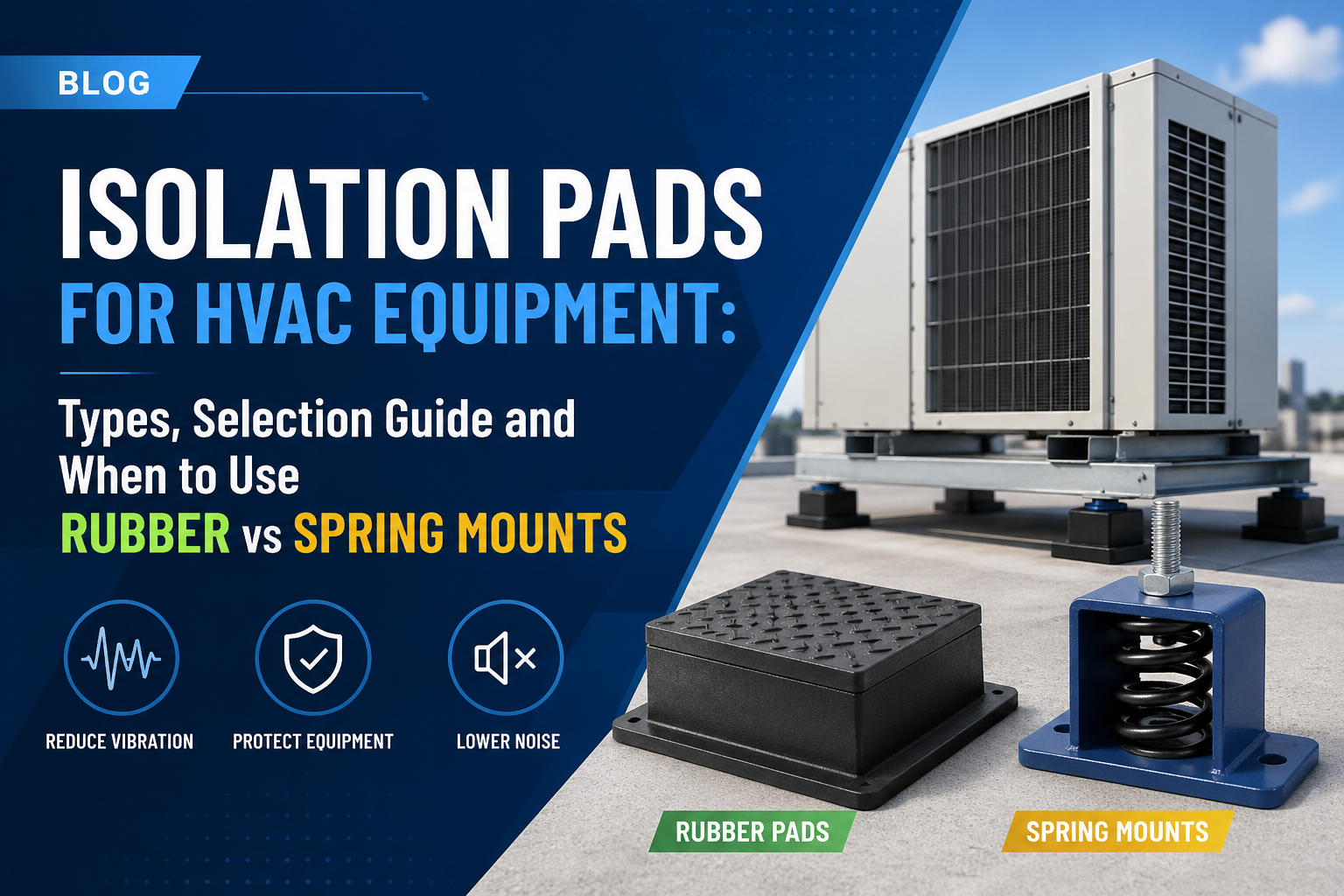
Isolation pads are the most accessible and widely used vibration control product in the HVAC industry. They sit between mechanical equipment and the floor — or between equipment feet and a support frame — and their job is to absorb and dissipate vibration before it reaches the building structure.
Choosing the wrong pad — or specifying no pad at all — leads directly to structure-borne noise, occupant complaints, and premature equipment wear. This guide covers the main types of isolation pads, how to select the right one for each equipment type, and when a pad alone is insufficient and spring isolators are required.
What Isolation Pads Do and How They Reduce Vibration Transmission
When a pump, compressor, generator, or AHU operates, it generates cyclical mechanical forces at its operating frequency. Without isolation, these forces transmit directly through the equipment feet into the floor slab, propagating as structure-borne noise through the building.
An isolation pad works by introducing a resilient layer that absorbs and dissipates mechanical energy rather than transmitting it. The effectiveness of the pad depends on three key factors: the material’s stiffness relative to the equipment load, the natural frequency of the pad-equipment system, and the degree of load distribution across the pad surface.
A correctly specified isolation pad reduces vibration transmission by 70 to 95% depending on the equipment type and operating frequency. An under-loaded or over-loaded pad can actually amplify vibration rather than reduce it.
Types of Isolation Pads: Materials, Designs, and Performance Characteristics
Rubber Waffle Pads — The Most Versatile General-Purpose Option
Rubber waffle pads are moulded with a raised waffle or ribbed pattern on both surfaces. The raised profile allows the rubber between the ribs to deflect freely under load, providing more effective isolation than a flat pad of the same thickness. The spaces between the ribs permit lateral expansion as vertical load is applied, which prevents creep and maintains consistent deflection under long-term loading. Waffle pads are effective for frequencies above 100 Hz and work well under small to medium HVAC equipment including air conditioning units, fan coil units, small pumps, and transformers.
Neoprene Ribbed Pads — Chemical and Temperature Resistant
Neoprene pads offer better oil and chemical resistance than natural rubber, making them the correct choice for installations where minor fluid contamination is possible — boiler rooms, refrigeration plant, or chemical dosing areas. Their temperature range is also wider, tolerating both elevated mechanical heat and sub-zero conditions.
Steel-Rubber Sandwich Pads (SRMP) — For Uneven Load Distribution
Where the equipment foot is smaller than the required pad area — common with pumps, boilers, and chillers with concentrated foot loads — a steel plate bonded between two rubber layers distributes the load evenly across the pad surface. This prevents stress concentration and ensures the rubber operates within its optimal deflection range across the full contact area.
Modular Cut-to-Size Pads — Flexible Field-Fit Solution
Modular rubber isolation pads consist of a sheet of 50mm x 50mm square modules joined by thin rubber webs. They can be cut on site to any size or shape, enabling exact coverage under any equipment footprint. This makes them particularly useful for non-standard equipment bases, retrofit installations, and projects where pad dimensions are not confirmed until installation.
EVA Foam Pads — For Light-Duty, High-Deflection Applications
EVA foam pads provide high deflection under low loads, making them suitable for small, lightweight equipment — domestic split AC units, heat pumps, small compressors, and household appliances — where a significant reduction in vibration is needed without the load-bearing demands of rubber.
High-Load Bearing (AASHTO Grade) Pads — For Heavy Industrial Equipment
AASHTO-grade elastomeric pads are engineered for very high compression loads in civil and heavy industrial installations — large generator sets, industrial compressors, and heavy process equipment. They maintain consistent deflection characteristics under sustained high loads without creep or permanent deformation.
How to Select the Right Isolation Pad: A Practical Step-by-Step Framework
Follow these steps to arrive at the correct pad specification for any HVAC or mechanical equipment installation:
- Determine the total equipment weight. Include the weight of the equipment, any fluid contained within it, and any additional loads from connected piping or accessories.
- Identify the equipment operating frequency. For rotating equipment, the primary disturbance frequency in Hz equals the RPM divided by 60. A 3000 RPM motor generates a primary frequency of 50 Hz.
- Determine the required natural frequency of the isolation system. For good isolation efficiency, the natural frequency of the pad-equipment system should be no more than one-third of the equipment’s disturbing frequency. For a 50 Hz motor, target a system natural frequency of 15 Hz or below.
- Calculate the load per unit area. Divide the total equipment weight by the total pad contact area. Match this to the pad manufacturer’s load rating for the specific pad thickness and material to ensure the pad operates in its optimal deflection range.
- Verify the deflection is within range. Most rubber pads perform optimally at 10 to 25% compression of their free thickness. Over-loading collapses the pad and eliminates isolation. Under-loading means the pad operates too stiffly and provides minimal benefit.
When Isolation Pads Are Not Enough: The Case for Spring Isolators
Isolation pads are highly effective for high-frequency vibration — above 50 to 100 Hz. But for low-speed, low-frequency equipment, pads alone cannot achieve the required isolation efficiency. This is when spring isolators become necessary.
Use spring isolators instead of or in addition to pads when:
- The equipment operates below 1500 RPM (25 Hz): Spring isolators provide the high static deflection needed to create a system natural frequency sufficiently below the disturbing frequency.
- The installation is on an upper floor or roof: Upper-floor slabs are more responsive to low-frequency vibration than ground-supported slabs. Spring isolators with 25 to 50mm static deflection are standard practice for rooftop plant.
- The adjacent spaces are highly noise-sensitive: Operating theatres, recording studios, hotel bedrooms adjacent to plant rooms, and precision laboratory environments require spring or air-mount isolation systems, not pads.
- Very heavy equipment is involved: Large centrifugal chillers and generator sets require the load-bearing capacity and deflection characteristics that only engineered spring assemblies or inertia bases can provide.
Common Mistakes When Installing Isolation Pads on HVAC Equipment
- Using the same pad for all equipment regardless of load: A pad rated for a 200 kg pump will not perform correctly under a 2,000 kg chiller. Always specify pads to the actual equipment load.
- Solid-bridging the isolation: Conduit, hard pipework, or anchor bolts that create a rigid metallic connection between the equipment and the structure bypass the pad entirely. All connected services must be acoustically decoupled.
- Using cork pads for permanent commercial installations: Cork degrades under sustained compression and provides inconsistent long-term performance. Rubber is the correct choice for commercial HVAC applications.
- Insufficient pad coverage area: The load must be distributed evenly across the pad surface. Point loading through equipment feet directly onto the pad will over-compress the pad locally and reduce isolation efficiency.
Conclusion
Isolation pads are the most cost-effective first line of defence against HVAC vibration — but only when correctly specified for the equipment weight, operating frequency, and installation context. For light to medium equipment operating above 50 Hz, the right rubber waffle or neoprene pad delivers excellent isolation. For heavy, low-speed, or rooftop equipment, move to spring isolators. And for any installation, ensure all connected services are acoustically decoupled to avoid bypassing the isolation entirely.
Vibro Limited supplies the full range of anti-vibration pads, spring isolators, and engineered vibration control products for HVAC and MEP applications. Explore our complete range of vibration isolation system solutions at vibrolimited.com.
Frequently Asked Questions
Q1: How many isolation pads do I need under a piece of HVAC equipment? The number of pads depends on the equipment footprint, its weight, and the load rating per pad unit. As a general rule, place pads under each equipment foot or frame contact point. For a pad rated at 40 kg per 50 x 50mm square, divide the total equipment weight by 40 to determine the total number of squares needed, then distribute them evenly across all contact points.
Q2: Can isolation pads be used outdoors on rooftop HVAC equipment in the UAE and KSA? Yes, but the pad material must be UV-resistant and rated for the thermal cycling of outdoor GCC conditions — where surface temperatures can exceed 70 degrees Celsius in summer. Neoprene pads with UV stabilisers perform well in outdoor applications. Avoid natural rubber pads outdoors as UV degradation will significantly reduce their service life.
Q3: What is the difference between vibration isolation pads and anti-vibration mounts? Isolation pads are flat or profiled elastomeric sheets placed under equipment — they require no bolting and rely on equipment weight for load transfer. Anti-vibration mounts are bolted assemblies that connect equipment to its support structure through a rubber or spring element. Mounts provide more controlled and consistent deflection characteristics and are preferred where equipment must be positively fixed to resist horizontal forces.
Q4: Do isolation pads help with both impact noise and airborne noise from HVAC equipment? Isolation pads primarily address structure-borne (impact) noise — the vibration transmitted from equipment through the floor into the building fabric. They do not significantly reduce airborne noise radiated directly from the equipment casing. Controlling airborne equipment noise requires acoustic enclosures, sound attenuators, or duct silencers in addition to vibration isolation.
Q5: How do I know if my isolation pads are still working correctly after years of service? Visually inspect pads annually for cracking, hardening, permanent deformation, or extrusion beyond the equipment footprint. A pad that has been permanently compressed flat is no longer providing isolation. If vibration or noise levels in occupied spaces have increased without a corresponding change in equipment condition, degraded or incorrectly loaded isolation pads are often the cause. Replace pads proactively every 7 to 10 years in commercial installations.


