

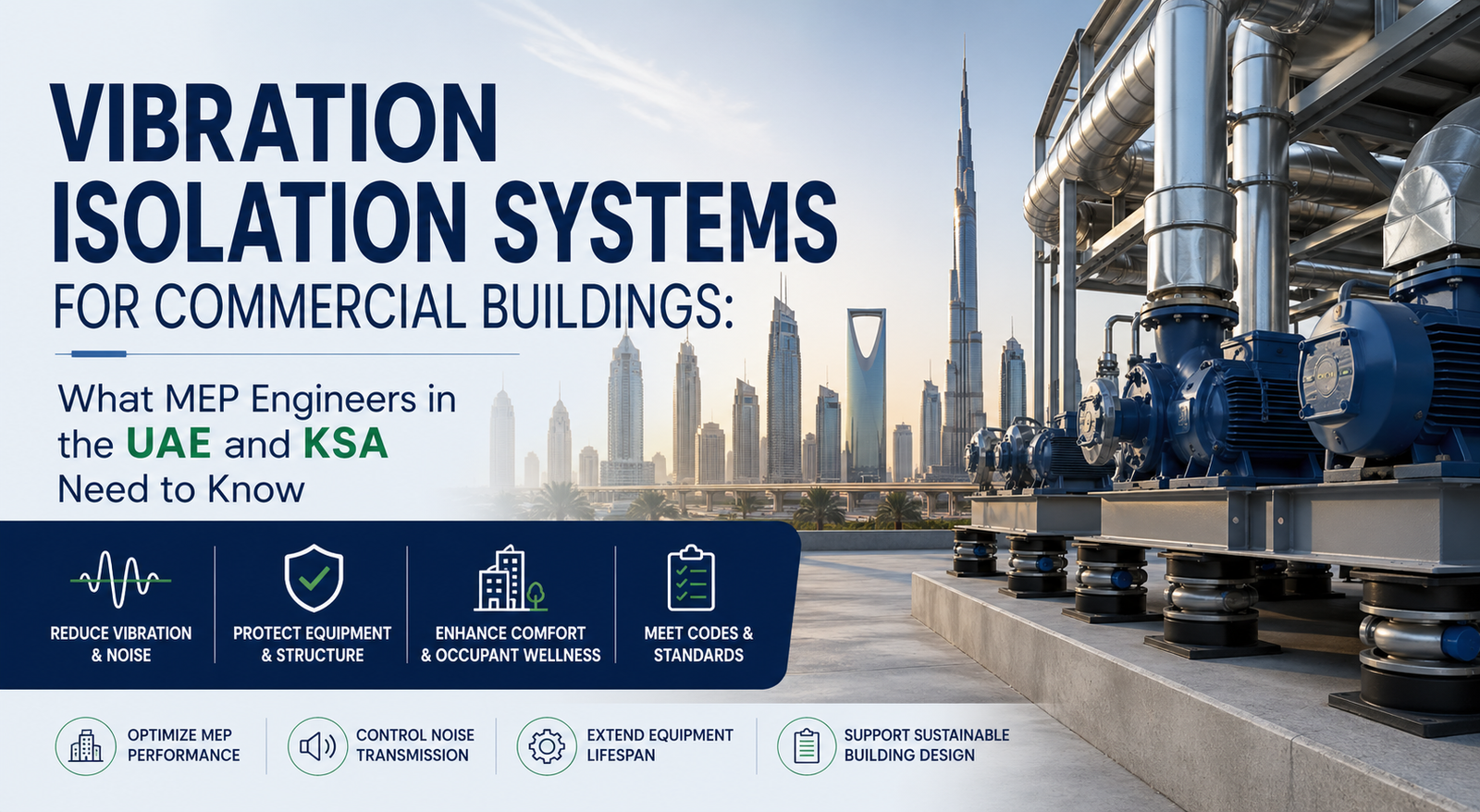
Every commercial building in the UAE and Saudi Arabia runs on mechanical and electrical systems: chillers, pumps, generators, air handling units, cooling towers, and transformers. All of these machines generate vibration. Without a properly engineered vibration isolation system, that vibration travels through the building structure and becomes noise, discomfort, and eventually structural wear.
For MEP engineers working on commercial projects in Dubai, Abu Dhabi, Riyadh, and Jeddah, getting vibration isolation right is no longer optional, it is a fundamental design responsibility. This guide covers the principles, product types, and common mistakes that define good vibration isolation practice in the GCC context.
Why Vibration Isolation Is a Critical MEP Design Consideration in GCC Commercial Projects
The GCC construction market produces some of the world’s most demanding built environments for vibration management. High rise mixed use towers place plant rooms adjacent to or directly above occupied floors. District cooling connections introduce external vibration sources. And the growing emphasis on hospitality, healthcare, and high specification office fit outs means occupant acoustic comfort expectations are extremely high.
Structure borne noise and vibration from inadequately isolated MEP equipment are among the most common post occupancy complaints in commercial buildings in the region. Fixing vibration problems after construction is expensive, disruptive, and often only partially effective. The right time to design vibration isolation into a project is during the MEP coordination and specification stage.
How Vibration Travels Through a Building Structure and Why Standard Mounts Are Not Enough
Vibration generated by rotating or reciprocating machinery transmits in two ways: as structure borne vibration through mounting surfaces and connected pipework, and as airborne noise radiated from equipment casings and ductwork.
A standard inertia base or simple rubber pad addresses only the direct mount to floor vibration path. In a fully connected mechanical system, vibration also travels through:
- Connected pipework that runs into the structure, this is why rubber flexible connectors on pump connections are essential.
- Electrical conduit and cable trays that provide a direct metallic path from equipment to structure.
- Ductwork connections where fan vibration propagates into the air distribution system.
- Housekeeping pads and equipment bases that act as rigid bridges between the isolator and the slab.
A complete vibration isolation design addresses all transmission paths, not just the equipment mount.
Types of Vibration Isolation Products Used in Commercial Building MEP Systems
Spring Isolators For Low Frequency, High Load Equipment
Spring isolators are the primary vibration control solution for heavy, low speed rotating equipment like large centrifugal chillers, cooling towers, generator sets, and primary pumps. Compression springs provide high static deflection, which is essential for isolating low frequency vibration typically below 25 Hz. For rooftop and upper floor plant rooms in UAE and KSA towers, spring isolators with neoprene cups or acoustically lined housings prevent both low frequency sway and high frequency vibration from reaching the slab.
Rubber Anti Vibration Mounts For Medium Speed Equipment and Fan Units
Rubber or neoprene anti vibration mounts are used for medium to high speed rotating equipment including FCUs, AHUs, small pumps, and fan coil systems. The natural frequency of the rubber mount must be selected to match the operating frequency of the equipment. A rubber mount selected for the wrong load range or frequency will perform worse than a correctly specified lower cost alternative.
Inertia Bases For Pumps and Fan Coil Systems Requiring Stability
An inertia base is a concrete or steel framed mass installed between the equipment and its spring isolators. It increases the total mass of the isolated system, lowering the natural frequency and improving isolation efficiency, particularly for pumps with high suction side piping loads and for equipment sensitive to rocking instability.
Vibration Isolation Hangers For Suspended Ductwork and Piping
Spring or rubber hanger isolators are used wherever ductwork, piping, or equipment is suspended from the structure above. In high specification commercial buildings, hanger isolators on the supply and return ductwork within 6 to 8 pipe diameters of fan equipment are standard practice for noise sensitive spaces.
MEP Vibration Isolation Design Principles for UAE and KSA High Rise Projects
Applying the following principles ensures that vibration isolation works as intended in GCC commercial buildings:
- Match isolator selection to operating speed. The natural frequency of the isolation system must be significantly below the disturbing frequency of the equipment. For a 1500 RPM pump, a spring isolator with a natural frequency of 2 to 3 Hz provides approximately 90% isolation efficiency.
- Isolate all connected services. Every pipe, duct, and conduit connection to isolated equipment must also be acoustically decoupled. Use rubber flexible connectors on all pump suction and discharge connections within the isolation zone.
- Consider structural transmission paths. Vibration does not only travel downward through isolators. It also travels laterally through the slab and up through columns. For critical applications, a vibration consultant should model transmission paths and specify appropriate isolation for each.
- Verify isolator loading after installation. Spring isolators must compress to within their rated deflection range to function correctly. After installation, check that all springs carry equal load and that the equipment base is level.
- Specify seismic restraint for critical equipment. UAE and KSA projects increasingly require seismic compliant installation for essential MEP equipment. Seismically restrained spring isolators maintain vibration isolation performance while providing earthquake protection.
Market Trends Driving Vibration Isolation Adoption Across GCC Commercial Projects
The GCC building vibration isolation market is expanding rapidly. Several converging trends are accelerating adoption:
- Smart building integration: Vibration isolation systems are increasingly being specified with integrated sensors for real time performance monitoring, predictive maintenance alerts, and BMS connectivity.
- Green building certification: LEED, Estidama, and GSAS certification frameworks include acoustic comfort and indoor environmental quality criteria that vibration isolation directly supports.
- Increasing mixed use density: As more GCC developments place residential, hospitality, and commercial uses within the same structure, acoustic performance requirements between floors and zones become significantly more demanding.
- Sustainable materials: Cork rubber composites, recycled rubber, and bio based polyurethane isolators are gaining specification share as developers pursue environmental credentials.
Conclusion
Vibration isolation is a systems engineering challenge, not a product selection afterthought. For MEP engineers working on commercial projects in the UAE and KSA, designing isolation into the project from the start across equipment mounts, pipe connections, ductwork, and structural transmission paths is what separates buildings that perform from buildings that generate complaints.
Vibro Limited provides engineered vibration isolation solutions for MEP applications across the GCC. Explore the complete range of spring isolators, hangers, isolation pads, and flexible connectors at vibrolimited.com.
Frequently Asked Questions
1. At what point in a commercial project should vibration isolation be designed? Vibration isolation should be designed during the MEP concept stage, before equipment schedules and plant room layouts are finalised. Specifying isolators as an afterthought once equipment is already placed and connected significantly limits the options available and often requires expensive structural interventions.
2. Which types of HVAC equipment require spring isolators rather than rubber mounts? Equipment with operating speeds below 1500 RPM or with high dynamic loads like large centrifugal or screw chillers, primary pumps above 15 kW, cooling towers, and generator sets generally requires spring isolators. Higher speed equipment including FCUs, small circulation pumps, and fan coil units can typically be isolated with rubber anti vibration mounts.
3. Does rooftop plant in UAE towers require different vibration isolation treatment than basement plant? Yes, significantly. Rooftop plant rooms sit directly above occupied floors, which means vibration transmission paths are shorter and impact noise reaches occupied spaces faster. Rooftop chillers and cooling towers require higher deflection spring isolators, full perimeter treatment of connected services, and often acoustic floating floors beneath the plant room slab.
4. How do MEP engineers verify that vibration isolation is working after handover? Post occupancy vibration testing involves measuring floor vibration levels in occupied spaces adjacent to or below plant rooms during full load equipment operation. Measurements are compared against design criteria. A simple preliminary check involves observing isolator deflection: spring isolators that are fully compressed or sitting on their stops are providing zero isolation.
5. Are there acoustic and vibration standards that apply to commercial buildings in the UAE and Saudi Arabia? Both the UAE and Saudi Arabia apply a mix of local building codes and internationally referenced standards. ASHRAE 2019 Chapter 49 (Noise and Vibration Control), ISO 10816 for vibration measurement, and the acoustic requirements within LEED and Estidama are commonly referenced in project specifications. Individual authorities such as Dubai Municipality and the Saudi Building Code may impose specific acoustic and mechanical performance requirements.


