

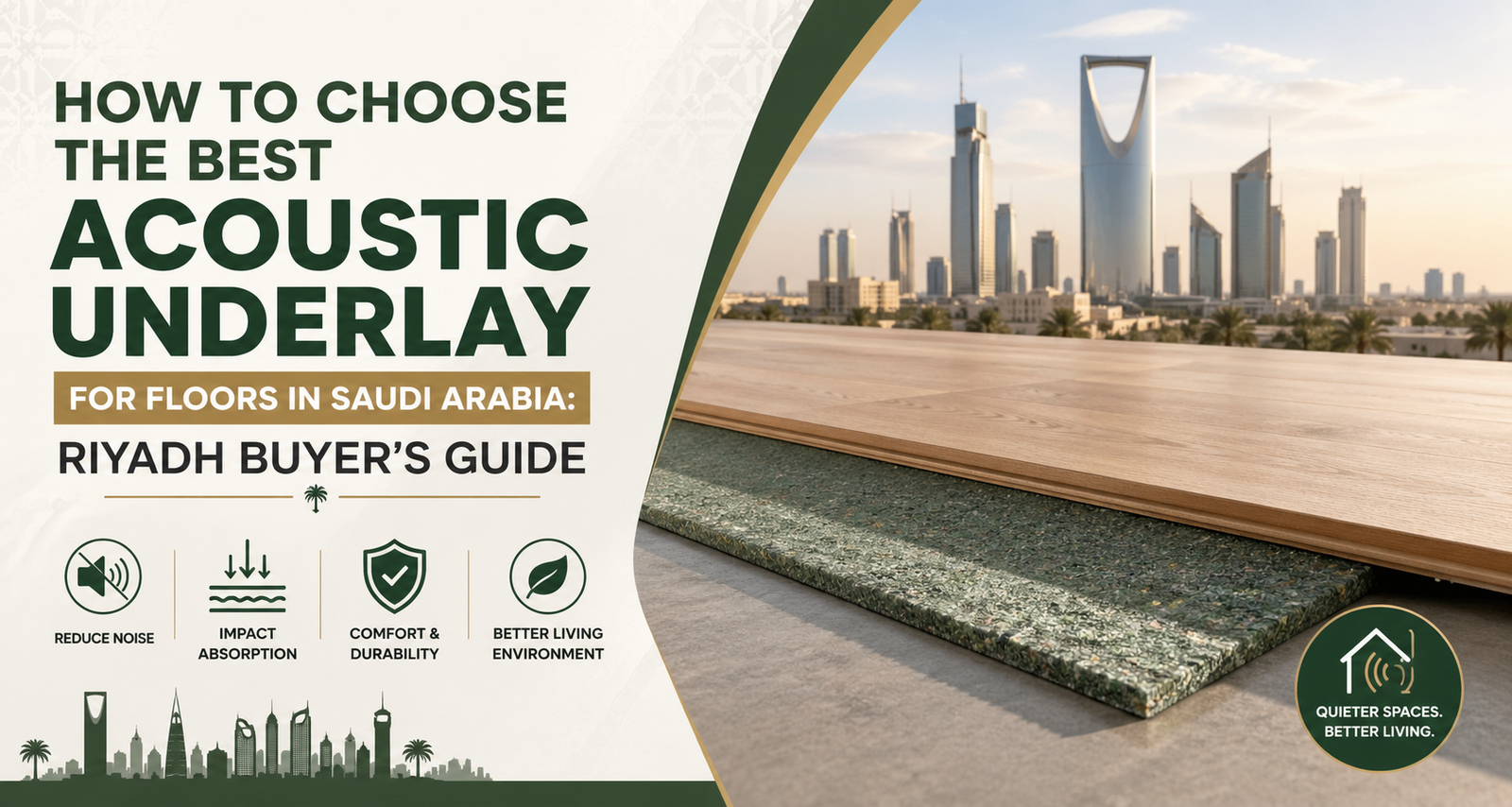
Noise travels fast in high rise apartments, commercial offices, and mixed use developments. In Riyadh, where modern construction is booming and vertical living is growing rapidly, floor noise footsteps, dropped objects, and vibrating equipment has become a serious comfort and compliance issue. The right acoustic underlay solves this problem at its root, before it ever reaches the slab.
This guide walks you through everything you need to know to select the best acoustic underlay in Riyadh covering materials, performance ratings, flooring compatibility, and what to watch out for when buying locally.
What Is Acoustic Underlay and Why Does It Matter for Saudi Buildings
Acoustic underlay is a layer of sound absorbing material installed between the subfloor and the finished flooring. Its primary job is to reduce two types of noise transmission: impact noise (footsteps, furniture movement) and airborne noise (voices, music, HVAC hum).
In Saudi Arabia, the demand for acoustic performance in buildings is growing steadily. Riyadh’s Vision 2030 construction wave has produced hundreds of residential towers, hospitality projects, and mixed use developments where floor to floor noise isolation is a key quality indicator. Architects and contractors increasingly specify acoustic underlays not as a luxury but as a building requirement.
The Key Performance Ratings You Must Understand Before Buying
When evaluating acoustic underlays, three performance metrics matter most.
IIC Impact Insulation Class
IIC measures how well a floor assembly reduces impact noise. A higher IIC number means better impact sound reduction. However, IIC tests the entire floor assembly not the underlay alone. Always ask suppliers for the Delta IIC rating, which isolates the underlay’s individual performance contribution.
STC Sound Transmission Class
STC measures airborne sound reduction between floors voices, TV audio, and music. For residential towers in Riyadh, a minimum STC of 50 is generally considered acceptable for occupant comfort.
Delta IIC The Most Reliable Comparison Tool
Delta IIC is the most accurate way to compare underlays side by side. It measures the improvement an underlay delivers above a bare concrete reference slab. When comparing products in the Saudi market, always ask for this number specifically not just the combined assembly rating.
Acoustic Underlay Materials Compared: Rubber, Cork, Foam, and MLV
Each material type offers a different balance of performance, durability, and cost. Here is how the main options compare for the Saudi climate and construction context.
Recycled Rubber Underlay Best All Round Performer
Recycled rubber is the highest performing underlay material for impact noise reduction. It delivers excellent Delta IIC values, resists compression over time, and performs consistently for 20 or more years. It works well under ceramic tiles, engineered hardwood, vinyl plank, and carpet making it the most versatile choice for Saudi commercial and residential projects.
Cork Underlay Natural and Sustainable, With Limitations
Cork provides natural sound damping, thermal insulation, and eco friendly credentials. However, it tends to degrade over time under heavy loads, and its moisture resistance in humid conditions is limited. Cork suits residential bedroom and living room applications but is not recommended for high traffic commercial floors.
Foam Underlay Affordable but Short Lived
Foam underlays are inexpensive and easy to install. However, they compress and flatten over time, significantly reducing their soundproofing effectiveness. For long term projects in Riyadh especially under LVT or laminate in high footfall areas foam is not a sound investment.
Mass Loaded Vinyl (MLV) Specialist Solution for Maximum Blocking
MLV is a dense, flexible barrier material used where airborne sound transmission is the primary concern recording studios, cinemas, hospitality suites, and high specification residential units. It is often combined with foam or rubber for combined impact and airborne noise control.
Choosing the Right Underlay for Your Floor Type in Saudi Arabia
Acoustic underlays are not universal. The flooring type on top, the subfloor material below, and the building’s acoustic requirements all determine which product to specify.
- Tiles and stone (common in Saudi interiors): Use rubber underlays rated for glue down or float installation. Rubber cork composites provide both decoupling and impact damping under heavy ceramic finishes.
- LVT and SPC flooring (growing in commercial fit outs): Choose high density foam with moisture barrier, or an integrated rubber backed LVT specifically rated for acoustic performance.
- Engineered hardwood: Dense rubber or rubber cork composites work best. They deliver warmth underfoot, impact noise control, and stability across temperature fluctuations important in air conditioned Saudi buildings.
- Carpet systems: Felt underlays or heavy rubber backed carpet cushions work well. For hospitality projects in Riyadh, a high density carpet underlay significantly reduces both noise and wear.
What to Check When Buying Acoustic Underlay in Riyadh
The Saudi market has a growing number of acoustic underlay suppliers, but product quality and specifications vary widely. Use this checklist when evaluating options:
- Ask for the test report, not just the rating. Always request the third party lab test document. It must include the test date, assembly description, and specific test method (ISO 10140 or ASTM).
- Verify VOC compliance. In enclosed Saudi buildings with central air conditioning, VOC off gassing from low quality underlays affects indoor air quality. Look for A+ VOC certification or equivalent.
- Check fire rating. Saudi building codes require materials to meet fire resistance standards. Confirm the underlay’s fire classification before specifying on commercial or multi storey residential projects.
- Confirm compatibility with radiant heated floors. Some luxury villas and hospitality projects in Riyadh use underfloor heating systems. Not all underlays are compatible rubber options generally are.
- Compare cost per square metre, not just the unit price. A thicker, higher rated rubber underlay at a slightly higher price point typically outlasts three cycles of foam replacement.
Riyadh Project Types and the Acoustic Underlay That Fits Each
Different project types in Riyadh call for different acoustic specifications. Here is a practical breakdown:
- High rise residential towers: Dense rubber underlay (6mm or above) under all hard flooring, with MLV barrier in party walls where required.
- Five star hotels and hospitality: Combination rubber cork underlay for guest room floors; carpet with high density felt underlay for corridors.
- Commercial offices: Mid density rubber or high density foam under LVT for open plan areas; rubber under raised access floor systems in data rooms.
- Schools and educational facilities: Rubber underlay under classroom floors reduces structure borne noise from adjacent corridors and activity rooms.
Conclusion
Choosing the right acoustic underlay for your Riyadh project comes down to three things: understanding the performance ratings that matter, matching the material to the flooring system, and verifying the product documentation before you buy. Rubber remains the highest performing and most durable option for the majority of Saudi applications both residential and commercial.
For expert guidance on acoustic solutions suited to the Saudi market, Vibro Limited offers a comprehensive range of tested and certified products. Explore the full range of vibration isolation and acoustic solutions at vibrolimited.com.


