

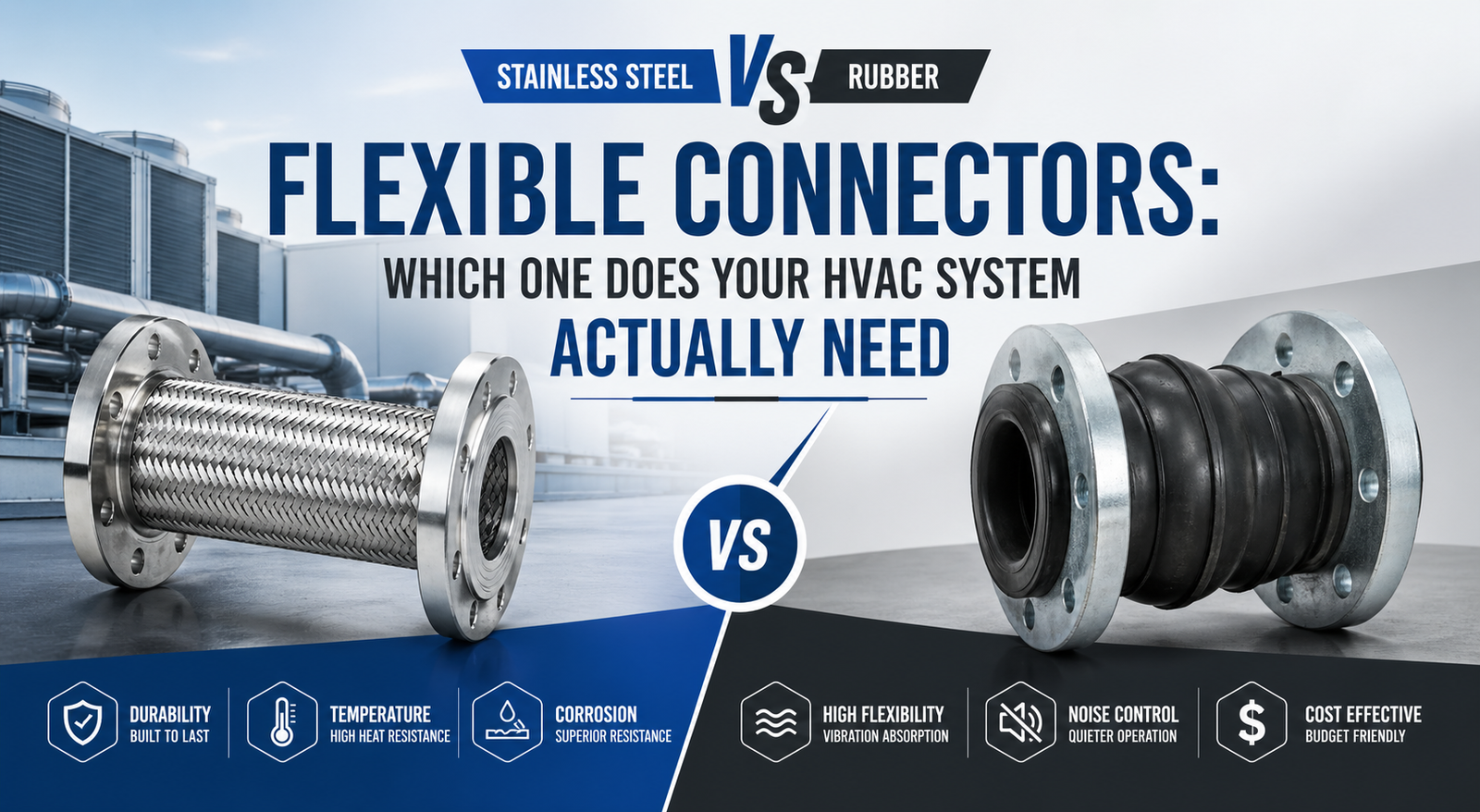
Walk into any mechanical plant room and you will see flexible connectors on pumps, chillers, air handlers, and pressurisation units. But not all flexible connectors do the same job. The choice between stainless steel flexible connectors and rubber flexible connectors is one of the most misunderstood decisions in HVAC piping design, and getting it wrong leads to vibration problems, noise complaints, and equipment damage.
This guide explains exactly what each connector type does, where it excels, where it fails, and how to make the right specification decision for your system.
What a Flexible Connector Actually Does in an HVAC System
A flexible connector is installed between a piece of mechanical equipment, a pump, chiller, cooling tower, or air handler, and the connected pipework. Its purpose is to handle four specific challenges: piping misalignment, thermal expansion and contraction, vibration attenuation, and noise reduction. No single connector type handles all four equally well. This is where most specification errors happen.
How Stainless Steel Flexible Connectors Work and Where They Perform Best
Stainless steel flexible connectors are constructed from corrugated bellows, typically 316L or 321 stainless steel, often reinforced with a stainless steel braid. They accommodate limited lateral offset and angular misalignment between piping and equipment flanges.
What stainless steel connectors do well:
- High pressure and high temperature service: suitable for steam lines, high temperature heating circuits, and pressurised water systems.
- Chemical and corrosive environments: the stainless construction resists aggressive fluids and external corrosion in plant rooms.
- Full vacuum service: stainless bellows withstand deep vacuum without collapsing, making them suitable for negative pressure applications.
- Long service life: stainless connectors generally outlast rubber equivalents and resist UV degradation, making them preferable for outdoor or roof mounted installations.
What stainless steel connectors do NOT do:
Stainless steel flexible connectors provide negligible vibration attenuation and almost no noise isolation. They do not absorb or dampen the mechanical vibration generated by rotating equipment. If vibration isolation is your primary goal, a stainless steel connector will not deliver it.
How Rubber Flexible Connectors Work and Where They Outperform Steel
Rubber flexible connectors are elastomeric bodies, typically EPDM, neoprene, or natural rubber, moulded or fabricated with metal flanges or end fittings. Their viscoelastic construction absorbs mechanical energy, which is what makes them effective at controlling vibration and noise.
Where rubber connectors excel:
- Vibration attenuation: rubber absorbs and dissipates mechanical vibration from pumps and rotating equipment, preventing it from transmitting through the pipework into the building structure.
- Noise isolation: the elastomeric body decouples the pipe from the equipment, significantly reducing structure borne noise in plant rooms and occupied floors above.
- Thermal expansion in HVAC systems: rubber connectors accommodate limited expansion and contraction in typical HVAC temperature ranges, reducing pipe stress.
- Electrolytic isolation: rubber bodies interrupt the metallic connection between pipe and equipment, which helps prevent galvanic corrosion in mixed metal systems.
Limitations of rubber connectors:
Rubber connectors are not suitable for high temperature steam service, aggressive chemical environments, or vacuum applications. They also have a shorter service life than stainless connectors and require periodic inspection for surface cracking and hardening.
The Decision Framework: Matching the Right Connector to Your Application
Use this decision logic when specifying flexible connectors for HVAC and mechanical systems:
- Noise or vibration is the primary concern: Specify rubber. Hotels, hospitals, residential buildings, and offices above plant rooms all require vibration isolated pipework.
- High temperature or high pressure service: Specify stainless steel. Heating circuits above 120 degrees Celsius, steam systems, and high pressure chilled water mains require the mechanical resilience of stainless bellows.
- Chemical or corrosive process: Specify stainless steel. Where the conveyed fluid or the external environment is corrosive, stainless construction is the correct choice.
- Standard chilled water or condenser water HVAC: Specify rubber. These systems operate within rubber’s temperature and pressure tolerance and benefit significantly from its vibration isolation properties.
- Outdoor or roof mounted installations: Specify stainless. UV exposure and extreme temperatures degrade rubber connectors over time. Stainless is the more durable external choice.
Common Installation Mistakes That Reduce Connector Performance
Even the correct connector type will underperform if installed incorrectly. These are the most frequent errors observed in HVAC installations:
- Pipe strain through the connector: If the piping to either side of the connector is not properly supported, thermal movement forces load through the connector body and accelerates failure.
- Over tightening rubber connectors: Rubber connectors require correct bolt torque. Over tightening compresses the rubber excessively, reducing its movement capacity and acoustic performance.
- Using stainless connectors where rubber is needed: This is particularly common in plant rooms where noise reaches occupied floors above. Stainless connectors carry vibration directly into the structure.
- Installing rubber connectors in high temperature service: Rubber will harden, crack, and fail prematurely in steam or high temperature heating applications. Always verify the system design temperature against the connector’s rating.
Conclusion
The choice between stainless steel and rubber flexible connectors is not a matter of one being better than the other, it is about matching the right tool to the right job. Use rubber where vibration and noise isolation matter. Use stainless where high temperature, high pressure, or chemical resistance is the priority.
Vibro Limited supplies a full range of vibration isolation and flexible connection solutions for HVAC and industrial applications. Explore the complete product range at vibrolimited.com.
Frequently Asked Questions
Q1: Can I replace a rubber flexible connector with a stainless steel one to improve durability?
You can, but you should not do so on systems where vibration and noise are concerns. Stainless steel connectors last longer than rubber, but they transmit mechanical vibration directly into the pipework and structure. If your HVAC system serves a hotel, hospital, or residential building, switching to stainless will likely generate noise complaints.
Q2: What rubber compound should I specify for chilled water systems?
EPDM rubber is the most widely specified compound for chilled water and condenser water HVAC applications. It offers excellent resistance to water, ozone, and the temperature range typical of cooling systems. Neoprene is also used and provides good oil resistance where minor fluid contamination is a risk.
Q3: Do flexible connectors need to be included in the anti vibration design alongside spring mounts?
Yes. Flexible connectors and vibration isolation mounts work as part of a complete vibration control system. A pump isolated on spring mounts but connected with rigid pipework still transmits vibration through the pipe connections. Rubber flexible connectors are an essential complement to spring or rubber inertia base isolators.
Q4: How often should flexible connectors be inspected on HVAC systems?
Rubber connectors should be visually inspected annually for surface cracking, hardening, bulging, or leakage. Most rubber connectors have a service life of 5 to 10 years depending on operating conditions. Stainless bellows should be inspected for corrosion, fatigue cracking around the braid, and visible deformation of the corrugations.
Q5: Are there flexible connectors that combine the benefits of rubber and stainless steel?
Yes. Some manufacturers produce stainless steel corrugated hoses with an external rubber jacket, or stainless bellows assemblies mounted within an elastomeric housing. These hybrid products offer corrosion resistance alongside improved vibration attenuation, useful in applications where neither pure rubber nor pure stainless fully meets the requirements.


