

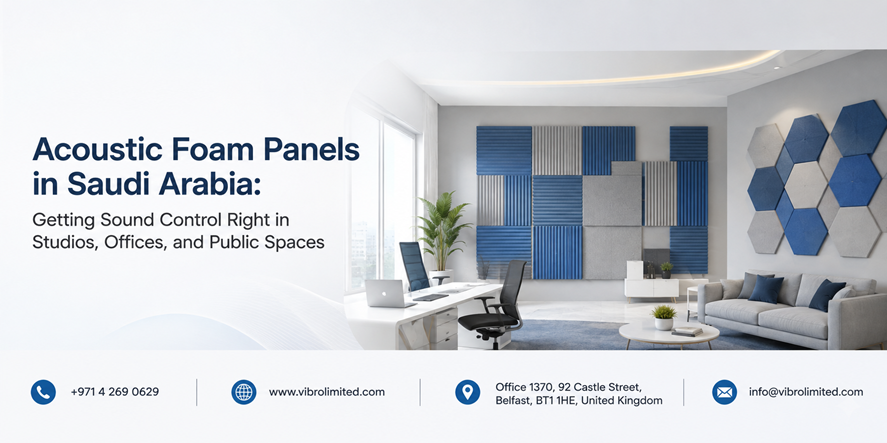
Riyadh and Jeddah have seen a genuine boom in recording studios, home theaters, corporate meeting spaces, and hospitality venues over the past several years, and nearly all of them run into the same problem at some point during fit-out: hard, reflective surfaces everywhere — glass, concrete, plaster — bouncing sound around a room until speech becomes hard to follow and recordings pick up an unwanted echo. Acoustic foam panels solve this specific problem, but only when the right panel shape is matched to the right acoustic issue, which is where a lot of projects in Saudi Arabia go wrong.
Why So Many New Builds in Saudi Arabia Need Acoustic Treatment
Modern commercial and residential construction across Saudi Arabia favors large glazed facades, polished concrete, and expansive open floor plans, all of which look striking but reflect sound aggressively rather than absorbing it. A meeting room with floor-to-ceiling glass and a hard ceiling can leave speech intelligibility noticeably poor, even in a relatively small space, simply because sound waves bounce repeatedly between parallel hard surfaces instead of being absorbed. Home theaters and recording studios face an even more specific challenge, since these spaces need to control both overall reverberation and specific frequency ranges to deliver accurate sound reproduction.
Acoustic foam panels address this directly by absorbing sound energy at the surface rather than letting it reflect back into the room, and different foam profiles are engineered for different parts of that problem.
The Main Foam Panel Profiles and What Each One Solves
Wedge foam panels contribute to a wideband absorber when combined with complementary materials, offering a modular design that adapts well to varied room shapes. These panels suit recording studios, control rooms, listening rooms, and home theaters where broad-spectrum absorption across the full audible range matters more than targeting one specific frequency band.
Pyramid foam panels use a four-sided conical structure that enhances absorption while introducing a degree of sound diffusion alongside it, creating a more dynamic acoustic environment rather than a completely deadened one. This makes pyramid foam a strong choice where a room needs meaningful absorption without feeling acoustically flat or lifeless, a common concern in home theaters and music rooms specifically.
Mushroom-head foam panels increase surface area through their distinctive profile, improving the panel’s ability to capture and dissipate sound waves and reducing noise interference for greater clarity. These suit environments requiring particularly precise sound control, including recording studios and dedicated music rooms where clarity is the primary objective.
Egg crate foam panels deliver strong high-frequency absorption through their waveform surface, making them especially suited to critical listening environments such as control rooms, mixing suites, and dedicated listening spaces where high-frequency reflections most directly interfere with accurate monitoring.
Choosing the Right Profile for Your Space
Matching foam profile to application matters more than most people expect walking into an acoustic treatment project for the first time. A home theater generally benefits from a mix of pyramid and wedge panels, balancing absorption with enough diffusion to keep the room feeling acoustically alive rather than muted. A professional recording booth or vocal isolation space typically calls for wedge or mushroom-head panels, where consistent, broad absorption prevents unwanted reflections from bleeding into a recording. Control rooms and mixing suites, where high-frequency accuracy is critical to trusting what’s being heard through the monitors, tend to perform best with egg crate panels specifically targeting that upper frequency range.
Beyond Studios: Where Else Acoustic Foam Panels Matter in Saudi Arabia
While recording studios and home theaters are the most obvious application, acoustic foam panels increasingly appear in corporate offices addressing open-plan noise complaints, hospitality venues managing restaurant and lobby acoustics, and educational facilities improving speech clarity in lecture halls and classrooms. Any space where hard, reflective surfaces dominate the interior finish is a candidate for acoustic foam treatment, regardless of whether music production was ever part of the original design brief.
What to Check Before Ordering Acoustic Foam for a Saudi Arabia Project
Fire safety compliance deserves particular attention given the building regulations that apply across commercial projects in Saudi Arabia, and it’s worth confirming a foam product’s fire rating directly with the supplier rather than assuming standard acoustic foam meets local commercial building code by default. Panel density and thickness also affect performance meaningfully — thicker panels generally absorb lower frequencies more effectively, which matters for spaces dealing with bass-heavy sound sources like home theater subwoofers or amplified music venues. Finally, installation method matters for long-term performance: panels properly adhered across their full surface area maintain consistent contact with the wall, while improperly mounted panels can develop gaps that undermine absorption at the very edges where sound tends to leak around treatment.
Who Typically Specifies This Work
Acoustic consultants and interior designers commonly specify foam panel type and placement during the design phase of studio and home theater projects, while facilities managers and office fit-out contractors increasingly request acoustic treatment as a practical fix for open-plan noise complaints after a space is already occupied. Both routes benefit from matching the panel profile to the specific acoustic problem rather than defaulting to a single foam type across the entire project.
Frequently Asked Questions
Which acoustic foam panel is best for a home theater in Saudi Arabia? A mix of pyramid and wedge panels typically works well, balancing sound absorption with enough diffusion to avoid an overly deadened listening environment.
Do acoustic foam panels need to meet fire safety standards for commercial use? Yes, and it’s important to confirm the specific fire rating of a foam product with the supplier before specifying it for a commercial project in Saudi Arabia.
What’s the difference between wedge and egg crate foam panels? Wedge panels provide broadband absorption suited to general studio and home theater use, while egg crate panels specifically target high-frequency absorption, making them well suited to control rooms and mixing suites.
Can acoustic foam panels help with office noise, not just studios? Yes — open-plan offices with hard, reflective surfaces benefit significantly from acoustic foam treatment to improve speech clarity and reduce general noise buildup.
Does foam thickness affect how well it absorbs low frequencies? Yes, thicker panels generally perform better at absorbing lower frequencies, which matters for spaces with bass-heavy sound sources such as home theaters and music venues.
Get the Right Foam Profile Specified for Your Space
Choosing between wedge, pyramid, mushroom-head, and egg crate foam panels depends on the specific acoustic issue your space needs to solve. For guidance matching foam profile to your studio, home theater, or commercial project in Saudi Arabia, contact the Vibro Limited team via WhatsApp at +971 527943637 or by phone at +971-527943637.


