

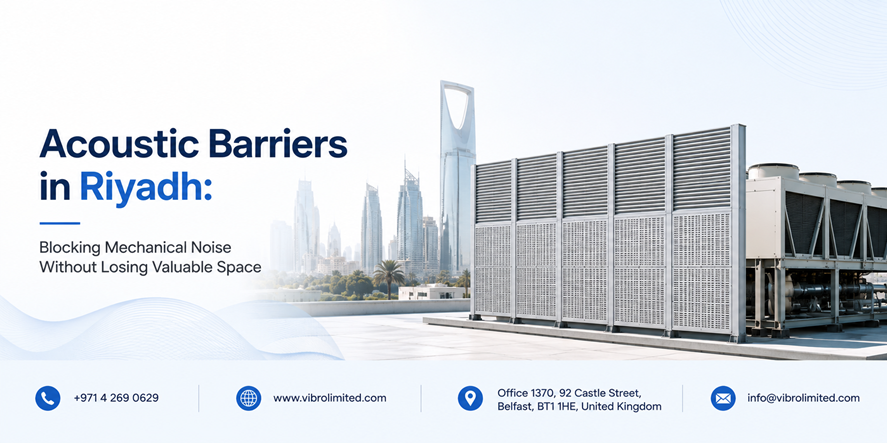
Riyadh’s rapid pace of commercial and residential construction has created a specific, recurring problem for building operators: mechanical rooms, ductwork, and pipe risers sitting closer to occupied space than older buildings typically allowed, thanks to increasingly efficient floor plans and taller mixed-use developments. When sound from mechanical equipment breaks through a wall, ceiling, or floor into an adjacent occupied space, the fix isn’t always more insulation. Often, what’s actually needed is a proper acoustic barrier, engineered specifically to block sound transmission rather than absorb it.
The distinction between absorption and blocking matters more than most building owners realize until they’ve paid for the wrong solution once already.
Why Absorption and Blocking Solve Different Problems
Acoustic foam and similar absorptive materials reduce reverberation within a room, softening echo and improving speech clarity inside that space. They do very little to stop sound from passing through a wall or ceiling into the next room. Acoustic barriers work on an entirely different principle: mass-loaded, limp materials that prevent sound waves from penetrating a structural assembly in the first place, rather than trying to absorb sound after it’s already inside the room.
This distinction is exactly why a mechanical room in Riyadh generating noticeable noise into an adjacent office or residential unit needs a barrier product, not foam panels. Foam treats a room’s internal acoustics. A barrier stops sound transmission between spaces entirely.
How Mass Loaded Vinyl Barriers Actually Work
VIBRO Barrier uses mass loaded vinyl technology specifically, delivering a flexible, high-density material that blocks sound transmission from mechanical systems, ductwork, pipes, and valve assemblies. The engineered limp mass construction prevents sound waves from penetrating walls, ceilings, and floors without consuming the significant amount of space that a rigid, mass-based solution like additional concrete or masonry would require.
This matters considerably in Riyadh’s commercial real estate context, where usable floor area carries real financial value, and losing space to a thick masonry wall solely for acoustic purposes is rarely acceptable to a developer or building owner. A flexible mass loaded vinyl barrier achieves comparable sound blocking performance in a fraction of the thickness.
Unlike rigid materials, which can introduce resonance problems of their own at certain frequencies, the limp mass construction of a proper acoustic barrier maintains consistent performance across the critical frequency ranges generated by engines, HVAC systems, and electronic equipment — exactly the sources most likely to cause noise complaints in Riyadh’s commercial and mixed-use buildings.
Practical Installation Advantages Worth Knowing
Superior tensile strength allows vertical installations in confined spaces, an important consideration in Riyadh’s mechanical rooms and pipe risers, which are frequently designed with tight tolerances to maximize usable floor area elsewhere in the building. The material also resists tearing during fabrication and handling, and cuts easily around complex penetrations, accommodating pipes, cables, and ductwork with precision rather than requiring the barrier to be interrupted or compromised at every connection point.
For applications with elevated fire safety requirements — a genuine concern in commercial buildings across Riyadh given local building code enforcement — acoustic barrier products are available with optional foil facing that enhances fire retardant properties, allowing the barrier to be specified confidently in fire-rated assemblies rather than treated as a compliance risk.
Where Acoustic Barriers Are Most Needed in Riyadh
Mechanical plant rooms sharing a wall or ceiling with occupied office or residential space are the most common application, particularly in mixed-use developments where commercial ground floors sit directly below residential units. Ductwork and pipe risers running through multiple floors of a building also benefit from barrier wrapping at points where they pass close to acoustically sensitive spaces, preventing noise breakout along the entire run rather than just at the mechanical room itself. Automotive and industrial facilities across Riyadh represent another significant application, where engine and machinery noise needs to be contained for both regulatory compliance and worker comfort.
What to Confirm Before Specifying an Acoustic Barrier in Riyadh
Fire rating compatibility deserves direct confirmation given Saudi Arabia’s building code requirements, particularly for barrier installations within fire-rated wall or ceiling assemblies. Barrier density and thickness should be matched to the specific frequency range of the noise source being addressed, since a barrier under-specified for a low-frequency mechanical noise source will underperform regardless of how well it’s installed. Installation quality around penetrations also matters significantly — a barrier with excellent bulk material performance can still underperform in practice if gaps around pipe or cable penetrations aren’t properly sealed during installation.
Who Typically Specifies Acoustic Barrier Solutions
Acoustic consultants generally specify barrier requirements during the design phase of commercial and mixed-use projects in Riyadh, particularly where mechanical rooms sit adjacent to noise-sensitive occupied space. Facilities managers dealing with an existing noise complaint in an already-constructed building often need a retrofit-friendly solution, which is where the flexibility and confined-space installation advantages of mass loaded vinyl barriers become particularly valuable compared to more disruptive structural fixes.
Frequently Asked Questions
What’s the difference between an acoustic barrier and acoustic foam? Acoustic foam absorbs sound within a room to reduce echo and improve clarity, while an acoustic barrier blocks sound transmission between spaces, preventing noise from passing through walls, ceilings, or floors.
Are mass loaded vinyl barriers effective in Riyadh’s commercial buildings? Yes — they provide effective sound blocking in a much thinner profile than rigid mass-based alternatives, which is particularly valuable in buildings where usable floor space carries significant commercial value.
Can acoustic barriers meet fire safety requirements in Saudi Arabia? Yes, when specified with the appropriate foil facing or fire-rated configuration, and this should be confirmed directly against local building code requirements before installation.
Where are acoustic barriers most commonly needed in Riyadh buildings? Mechanical plant rooms adjacent to occupied space, ductwork and pipe risers passing through multiple floors, and industrial facilities managing machinery noise are the most common applications.
Can acoustic barriers be retrofitted into an existing building with a noise complaint? Yes — their flexibility and ability to be installed in confined spaces make them a practical retrofit solution compared to more disruptive structural interventions.
Solve Mechanical Noise Breakout in Your Riyadh Building
Blocking sound transmission from mechanical rooms, ductwork, and pipe risers requires a barrier product engineered specifically for that purpose, not an absorptive material treating the wrong problem. For guidance specifying the right acoustic barrier for your Riyadh project, contact the Vibro Limited team via WhatsApp at +971 527943637 or by phone at +971-527943637.


