

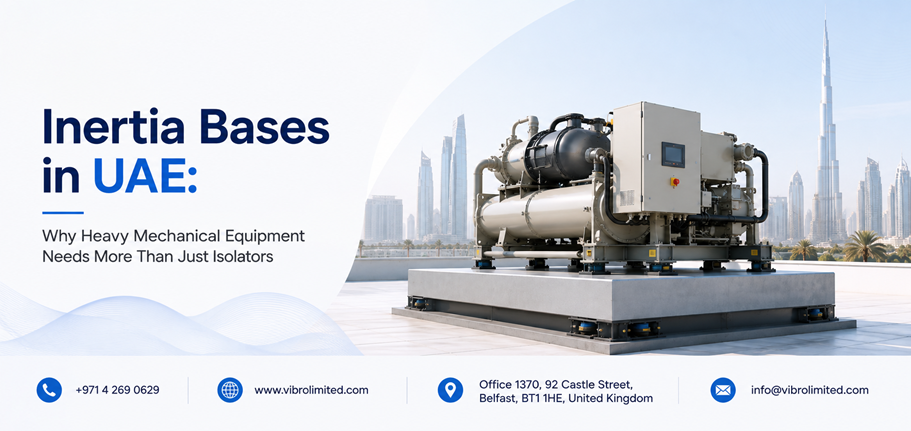
Anyone who has worked around a central plant room in a UAE tower knows the sight: a large centrifugal chiller or reciprocating compressor sitting on isolators alone, vibrating just enough under load to make nearby piping connections work loose over time, or transmitting a low, persistent hum into the structural slab beneath it. Spring isolators do genuinely good work reducing vibration transmission, but for certain categories of heavy mechanical equipment, isolators alone aren’t the complete answer. That’s where inertia bases come in, and understanding when a project actually needs one is a detail worth getting right during design rather than discovering after installation.
What an Inertia Base Actually Solves
An inertia base is a fabricated steel frame, filled with concrete on site, that creates a heavy, rigid foundation beneath mechanical equipment before isolators are even added into the system. The added mass fundamentally changes how the equipment interacts with its isolation system. Heavier equipment, when isolated properly, achieves lower vibration amplitude for a given isolator selection than the same equipment isolated without the added mass, simply because more mass resists the equipment’s own operational forces more effectively.
The VRCB model, for example, features an integrated design combining perimeter steel channels, isolator mounting brackets, reinforcing steel rods at 203 mm intervals, and pre-positioned anchor bolts. This unified structure strategically uses steel under tension and concrete under compression, which achieves superior strength and rigidity while minimizing overall material usage compared to conventional heavy steel foundation designs.
Why This Matters Specifically for UAE Mechanical Installations
UAE buildings run their mechanical plant hard for the majority of the year given the region’s climate, which means chillers, compressors, and pumps in this market operate at high load far more consistently than equivalent equipment in more temperate climates. That sustained operating profile makes stability and long-term isolation performance genuinely more important here than in markets where mechanical plant runs seasonally rather than continuously.
Tall UAE towers also frequently place substantial mechanical plant on upper floors or rooftop plant rooms rather than only at grade level, which changes the structural dynamics involved. An inertia base lowers equipment’s effective center of gravity and improves overall stability at these elevated plant locations, addressing a structural concern that isolators alone, however well selected, cannot fully resolve on their own.
What Equipment Genuinely Benefits From an Inertia Base
Inertia bases are specifically suited to centrifugal chillers, reciprocating compressors, pumps, fans, and engines — generally larger, heavier rotating or reciprocating equipment where vibration amplitude control and secure anchorage both matter significantly. Available in thicknesses ranging from 150 mm to 350 mm, inertia base frames can be matched to the specific weight and vibration characteristics of the equipment being installed, rather than treating every application with a single standard thickness regardless of load.
Lighter equipment, by contrast, rarely justifies the added cost and installation complexity of an inertia base. Fan coil units, small pumps, and light ductwork typically achieve adequate isolation through spring or elastomeric isolators alone, without the additional mass an inertia base provides.
How Inertia Bases and Isolators Work Together
An inertia base is not a replacement for proper isolator selection — it’s a complementary system designed to work alongside appropriately selected VIBRO ISOLATORS. When paired correctly, the combination provides superior equipment isolation, more effective vibration amplitude control, and secure anchorage, while simultaneously lowering the equipment’s center of gravity and improving airborne noise blocking performance. Specifying an inertia base without pairing it with correctly sized isolators, or vice versa, leaves meaningful performance on the table that a properly integrated system would have delivered.
Installation Advantages Relevant to UAE Construction Timelines
Given the pace of construction across major UAE developments, installation speed carries real project value. Inertia base frames of this type arrive fully welded and installation ready, which significantly reduces on-site labor and project timelines compared to fabricating a heavy steel or reinforced concrete foundation from scratch on site. For contractors working against tight UAE construction schedules, this prefabricated approach removes a potential bottleneck from the mechanical installation sequence without compromising the quality of the finished foundation.
What to Confirm Before Specifying an Inertia Base for a UAE Project
Frame thickness should be matched directly to equipment weight and vibration characteristics rather than selected generically, and this is a detail worth confirming with technical support rather than estimating independently. Isolator pairing needs equal attention, since an inertia base performs only as well as the isolators supporting it. Anchor bolt positioning should also be reviewed against the specific equipment’s mounting footprint before the frame is fabricated, since pre-positioned anchor bolts on a prefabricated frame need to align precisely with the equipment being installed.
Who Specifies and Uses Inertia Bases on UAE Projects
MEP consultants typically specify inertia base requirements during design development for larger central plant equipment, particularly on hospitality, healthcare, and high-end residential projects where noise and vibration performance carry direct commercial consequences. Mechanical contractors then coordinate inertia base procurement and installation alongside the broader equipment installation sequence, ensuring the base, isolators, and equipment arrive and integrate together rather than as disconnected line items on a purchase order.
Frequently Asked Questions
What is the difference between an inertia base and a standard vibration isolator? An isolator reduces vibration transmission at the mounting point, while an inertia base adds mass and rigidity beneath the equipment, improving overall stability and reducing vibration amplitude before isolators are even engaged.
Does all mechanical equipment need an inertia base in the UAE? No — inertia bases are generally reserved for heavier equipment such as chillers, compressors, and large pumps, while lighter equipment typically achieves adequate isolation through isolators alone.
What thickness of inertia base is appropriate for a given piece of equipment? Thickness, typically ranging from 150 mm to 350 mm, should be matched to the specific weight and vibration characteristics of the equipment, which is best confirmed with technical guidance rather than estimated generically.
Do inertia bases speed up installation on UAE construction projects? Yes — prefabricated, fully welded frames significantly reduce on-site labor and installation time compared to building a heavy foundation from scratch.
Can an inertia base be installed without isolators? It can, but doing so leaves significant performance on the table. Inertia bases are designed to work alongside properly selected isolators for full vibration and amplitude control.
Get Your Inertia Base and Isolator System Specified Together
Pairing the right inertia base thickness with correctly selected isolators is a technical decision that benefits from direct engineering input, particularly given the demanding operating conditions of UAE mechanical plant. Contact the Vibro Limited team via WhatsApp at +971 527943637 or by phone at +971-527943637 to discuss your specific equipment and project requirements.


