

A standard spring isolator does its job well under normal operating conditions. It carries the equipment load, compresses to its rated deflection, and interrupts the vibration path between the machine and the structure. But apply an uplift force — from seismic ground motion, wind loading, or equipment start-up surge — and the spring can extend beyond its working range, the equipment can lift off its mounts, and in a worst case, the machine tips, moves, or fails.
Restrained spring isolators solve this problem. They provide the same vibration isolation performance as a free-standing spring, while adding a mechanical restraint that limits both upward and lateral movement to a controlled gap. This guide explains the technology, the applications that require it, and how to specify the VRSIR correctly.
How a Restrained Spring Isolator Works
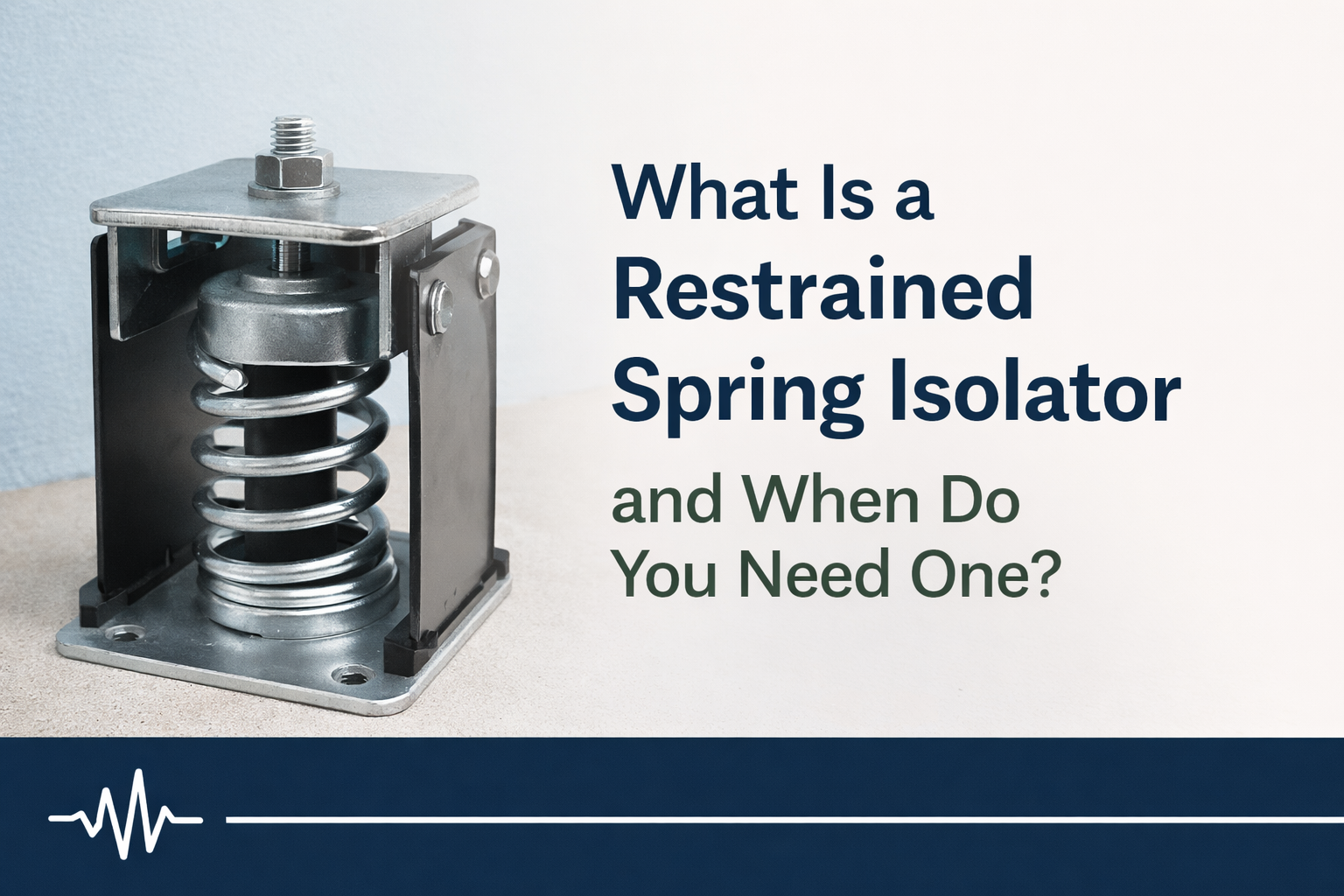
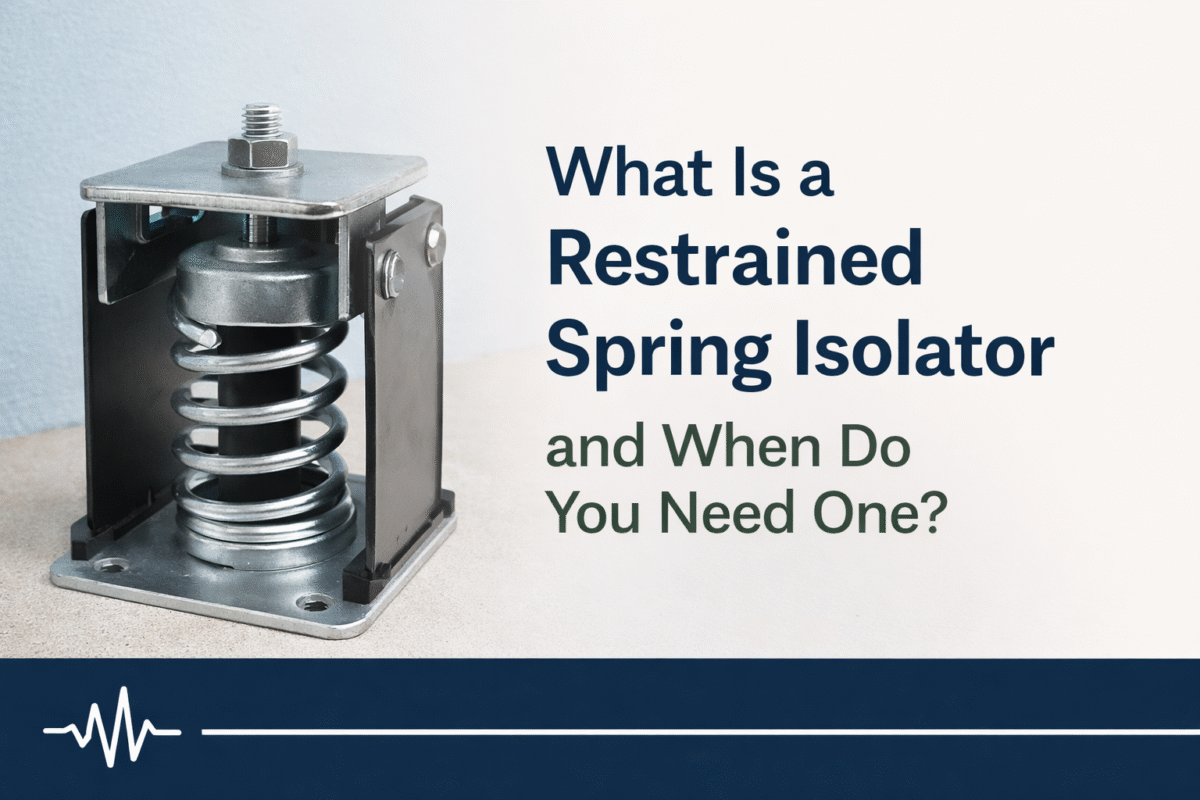
A restrained spring isolator — the VRSIR product category — houses a helical steel spring inside a bolted steel housing with a top and bottom restraint plate. The spring sits between the plates, compressed to its working deflection under the equipment load.
The restraint plates incorporate a controlled snubbing gap — typically 3 to 6 mm — between the moving element and the housing. Under normal operating conditions, the spring floats freely within this gap and vibration isolation performance is identical to an unrestrained isolator. When an uplift or lateral force exceeds the weight of the equipment, the restraint engages and the housing carries the load rather than the spring.
The result is a mount that isolates vibration under normal conditions and becomes a structural anchor under extreme loading — without the two functions interfering with each other.
When Do You Need a Restrained Spring Isolator?
1. Rooftop Mechanical Equipment
Rooftop plant sits in the highest wind-speed zone of any building. Cooling towers, air handling units, condensing units, and exhaust fans on a roof experience wind uplift forces that can significantly exceed the equipment’s operating weight — particularly for lightweight packaged units with large surface areas.
An unrestrained spring isolator on a rooftop allows the equipment to lift, rock, and potentially overturn in high wind events. Restrained isolators prevent this while maintaining full isolation performance during normal operation.
2. Seismic Applications
In seismic zones, ground acceleration subjects mechanical equipment to lateral and vertical forces that an unrestrained isolator cannot resist. The spring extends, the equipment shifts on its mounts, and the connected pipework and ductwork is placed under stress.
Seismic-rated restrained spring isolators carry certification to IBC, ASCE 7, or equivalent standards, confirming the housing can resist the design seismic force without the restraint gap closing and short-circuiting the isolation.
3. Equipment With High Start-Up Torque or Dynamic Loading
Large centrifugal chillers, reciprocating compressors, and multi-fan AHUs generate significant dynamic forces at start-up and during capacity changes. An unrestrained isolator allows the equipment to rock on its mounts, stressing connected services and potentially walking across the plant room.
Restrained isolators limit this motion to the snubbing gap, preventing equipment migration while allowing free vibration isolation during steady-state operation.
4. Suspended Equipment
Ceiling-suspended air handling units, fan coil units, and ductwork hangers can benefit from restrained isolation where uplift forces from pressure differentials or fan surges are a concern. Restrained hanger isolators serve the same function as restrained floor-mounted types.
VRSIR Product Specification
| Parameter | VRSIR Specification |
| Housing | Heavy-gauge welded steel with hot-dip galvanised or epoxy coating |
| Spring element | Helical steel spring, colour-coded by load range |
| Static deflection | 25 mm standard; 50 mm available for sensitive applications |
| Snubbing gap | 3 to 6 mm standard; adjustable on some configurations |
| Mounting | Bolt-down floor plate; through-bolt or inertia base fixing |
| Load range | 50 kg to 2,500 kg per mount depending on spring selection |
| Certifications | Available with seismic certification to IBC / ASCE 7 / EN standards |
| Neoprene base | Integral neoprene base pad for high-frequency attenuation |
Restrained vs Unrestrained: Choosing the Right Type
Not every spring isolator application requires restraint. Specifying restrained isolators where they are not needed adds cost without benefit. Use this framework to decide:
| Condition | Unrestrained (VRSIF/VRSIH) | Restrained (VRSIR) |
| Ground-level plant room | Appropriate | Not required |
| Rooftop installation | Not appropriate | Required |
| Seismic design zone | Not appropriate | Required |
| High wind exposure | Not appropriate | Required |
| Large reciprocating plant | Marginal | Recommended |
| Basement plant room | Appropriate | Optional |
| Suspended ceiling AHU | Not appropriate | Required |
The Snubbing Gap: Getting It Right
The snubbing gap is the critical dimension in a restrained isolator. Too small and the restraint engages under normal vibration amplitude — it short-circuits the isolation and the mount behaves like a rigid fixing. Too large and the restraint allows excessive equipment movement before it engages, placing unacceptable stress on connected services.
The correct snubbing gap is determined by the vibration amplitude at the mount location — which depends on equipment type, speed, and imbalance. For most HVAC applications, 3–4 mm is correct. For large reciprocating plant with high vibration amplitude, 5–6 mm may be appropriate.
Never select a restrained isolator by load capacity alone. Always confirm the snubbing gap is appropriate for the application’s vibration amplitude.
Installation Requirements for Restrained Isolators
- The housing must be bolted to the structural substrate — the restraint function only works if the housing cannot move
- Confirm the substrate can carry both the static equipment load and the design restraint force simultaneously
- Level the equipment using the integral levelling bolt before tightening the top restraint plate
- Confirm the snubbing gap is uniform around the perimeter after installation and loading
- For seismic-rated installations, use the certified hardware supplied with the product — do not substitute fixings
- Connect flexible pipe connectors and flexible duct connections at all service entry points — the isolator allows controlled movement, and the services must accommodate this
Common Specification Errors
The most frequent errors when specifying restrained spring isolators are:
- Using unrestrained isolators on rooftop applications — this is the single most common vibration isolation installation failure
- Selecting restrained isolators but not bolting the housing down — an unanchored restrained isolator provides no restraint
- Specifying the wrong snubbing gap — an over-tight gap defeats the isolation; an over-large gap allows damaging movement
- Failing to specify seismic certification when the project design code requires it — this creates a compliance gap that emerges at commissioning
Selecting the Right Product
Vibro Limited supplies the VRSIR restrained spring isolator range in load capacities from 50 kg to 2,500 kg per mount, with standard 25 mm static deflection and seismic-certified configurations available for projects in design seismic zones. Full load-deflection curves, snubbing gap recommendations, and fixing details are available in the product technical submittal.
For rooftop plant specifications, provide equipment weight (operating and installed), wind design speed, and floor or roof slab construction to allow the correct product and fixing configuration to be confirmed.
Key Takeaways
- Restrained spring isolators provide full vibration isolation under normal conditions and mechanical restraint under extreme loading
- Rooftop installations require restrained isolators — this is non-negotiable
- Seismic design zones require certified restrained isolators with documented force resistance
- The snubbing gap must be matched to the application’s vibration amplitude — not just set to minimum
- The housing must be structurally anchored for the restraint function to work


