

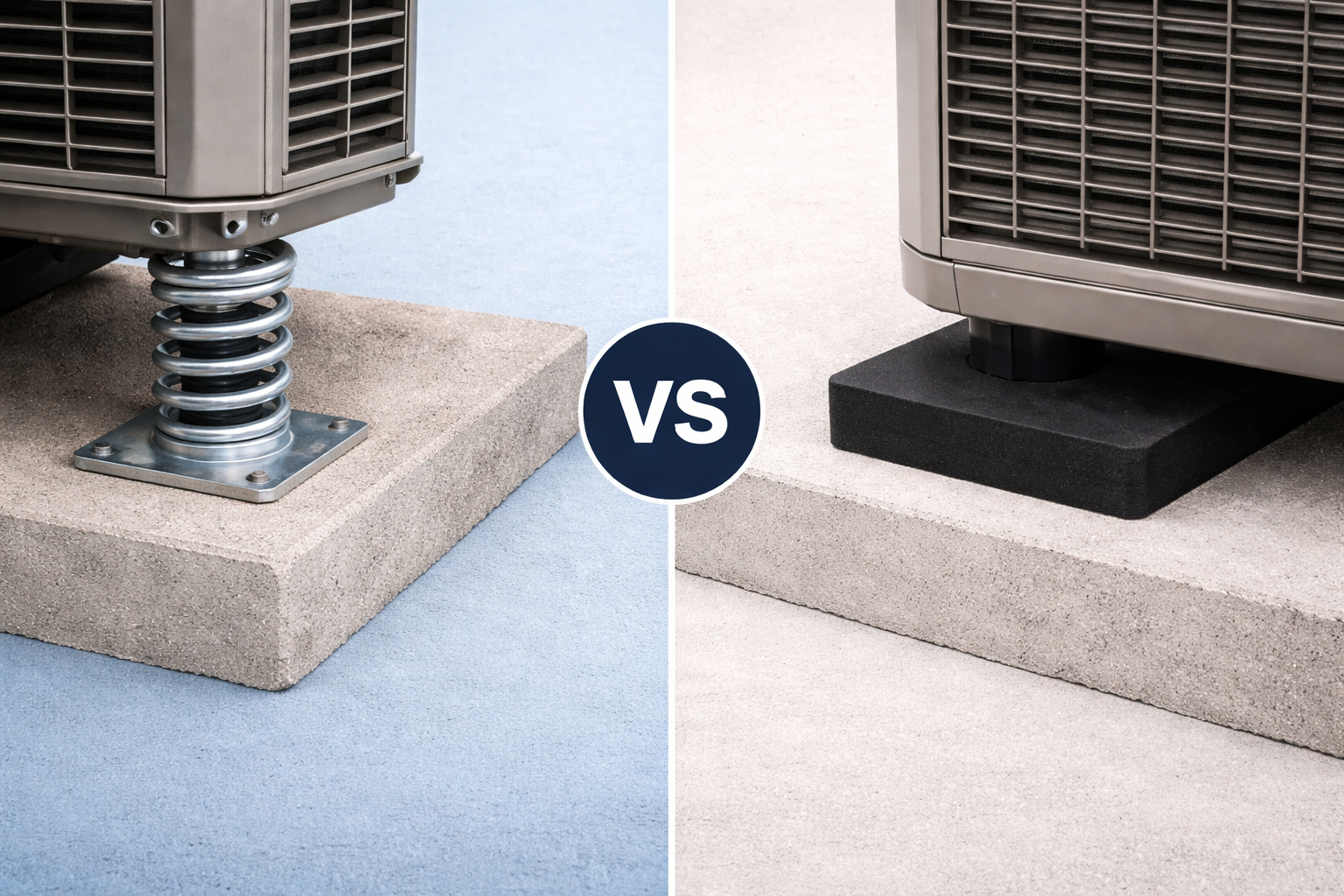
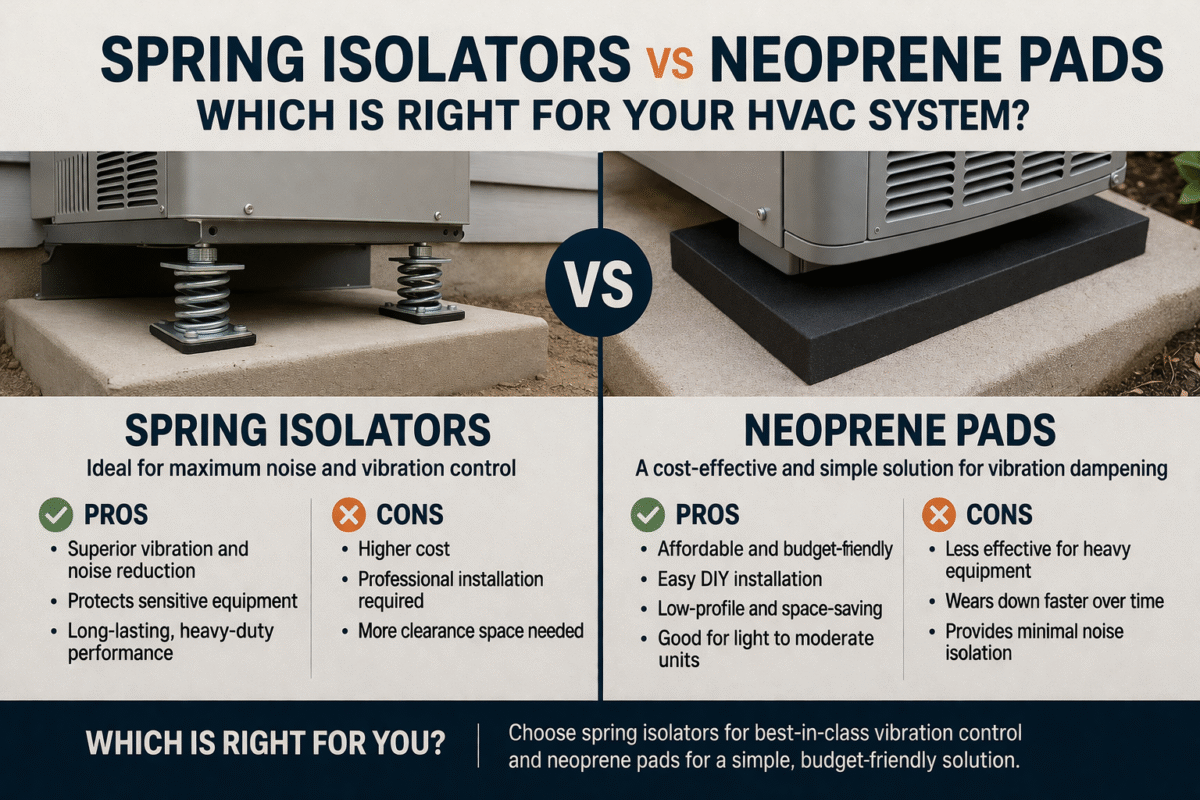
Every HVAC system generates vibration. Compressors, fans, pumps, and air handling units transmit that vibration directly into the building structure unless you interrupt the path. That interruption is the job of vibration isolation — and the two most common tools for the job are spring isolators and neoprene pads.
MEP engineers face this choice on almost every mechanical plant specification. Get it right and the building is quiet, the equipment runs efficiently, and the client notices nothing. Get it wrong and the vibration complaint arrives before the project closes out.
This guide gives you the practical framework to make the right call every time.
The Core Principle: Static Deflection
Before comparing products, you need to understand the one metric that determines isolation effectiveness: static deflection.
Static deflection is the amount a mount compresses under its rated load. Greater deflection means lower natural frequency, which means better isolation of the frequencies your equipment generates. The relationship is straightforward:
- 25 mm deflection achieves approximately 97% isolation efficiency at typical HVAC forcing frequencies
- 6 mm deflection achieves approximately 90% isolation efficiency
- 1.5 mm deflection achieves approximately 75% isolation efficiency
Spring isolators routinely achieve 25–50 mm static deflection. Neoprene pads typically deliver 1.5–6 mm. That gap defines the limits of each technology and tells you when one is appropriate and the other is not.
Spring Isolators: When to Use Them
Spring isolators use a helical steel spring as the primary isolation element, housed in a steel or cast iron cup with a levelling bolt and a neoprene base pad. The spring provides high deflection; the neoprene base prevents high-frequency transmission that can bridge a stiff spring.
Use spring isolators when:
- Equipment runs at low speed — below 1,200 RPM — where only high deflection achieves effective isolation
- The equipment sits on a long-span or lightweight floor structure sensitive to dynamic loads
- The application is a central plant room with large chillers, cooling towers, or primary air handling units
- Noise criteria in adjacent occupied spaces are stringent — NC-25 or lower
- You need to isolate a large pump or fan set where differential deflection between mounts must be controlled
VRSIF and VRSIH spring isolators
Free-standing spring isolators like the VRSIF (floor-mounted) and VRSIH (housed, with internal height adjustment) are the standard specification for central plant and mechanical room applications. They accommodate point loads from 50 kg to several tonnes per mount, offer adjustable spring heights for equipment levelling, and carry a neoprene base pad to attenuate high-frequency structure-borne noise.
The housed variants include a steel housing that limits lateral movement and provides a degree of built-in snubbing — important in plant rooms where equipment can shift during start-up surges.
Neoprene Pads: When to Use Them
Neoprene anti-vibration pads are moulded from natural or synthetic rubber compounds, available in sheet or moulded pad form, in a range of durometer (hardness) ratings that correspond to different load capacities.
They are simple, cost-effective, and appropriate for a well-defined range of applications.
Use neoprene pads when:
- Equipment operates at high speed — above 1,500 RPM — where the forcing frequency is well above the system’s natural frequency even with low deflection
- The application involves small fan coil units, terminal units, small split system condensers, or pump sets below 7.5 kW
- The floor is a ground-level concrete slab with high mass and stiffness
- Budget is constrained and the noise criteria allow it
- The installation requires a thin profile — under raised access floors or in low-clearance plant spaces
VRCP and VRNP neoprene pads
The VRCP (ribbed neoprene pad) and VRNP (neoprene levelling pad) are the standard products for these applications. The ribbed profile of the VRCP increases effective deflection relative to a flat pad of the same hardness — the ribs compress independently, lowering the pad’s dynamic stiffness without reducing its load capacity.
The VRNP provides a flat bearing surface for use under equipment base frames and inertia bases where a uniform load distribution is required.
Spring Isolators vs Neoprene Pads: Direct Comparison
| Parameter | Spring Isolators (VRSIF / VRSIH) | Neoprene Pads (VRCP / VRNP) |
| Static Deflection | 25 to 50 mm typical | 1.5 to 6 mm typical |
| Isolation Efficiency | 95 to 98% at HVAC frequencies | 75 to 90% at HVAC frequencies |
| Equipment Speed | Best below 1,200 RPM | Best above 1,500 RPM |
| Floor Sensitivity | Suitable for all floor types | Concrete slab preferred |
| Load Range | 50 kg to several tonnes | Light to medium loads |
| Profile / Height | 100 to 200 mm installed | 10 to 50 mm |
| Levelling | Integral levelling bolt | Shims required |
| Lateral Restraint | Available (VRSIH housed type) | Limited — pads can walk |
| Cost | Higher | Lower |
| Best Application | Chillers, AHUs, large pumps | FCUs, condensers, small pumps |
The Decision Framework for MEP Engineers
Work through these questions in order to reach the right specification:
Step 1: What is the equipment’s operating speed?
Equipment running below 900 RPM demands spring isolators. No neoprene product delivers sufficient deflection to isolate low-frequency vibration from slow-speed rotating plant. Above 1,500 RPM, neoprene pads may be sufficient — but step 2 determines this.
Step 2: What is the floor structure?
Long-span composite decks, post-tensioned slabs, and raised floors transmit vibration efficiently. If the mechanical equipment sits above occupied office, residential, or hospitality space on a lightweight floor, specify spring isolators regardless of equipment speed.
Step 3: What are the noise criteria?
If the project specifies NC-30 or lower in adjacent spaces, spring isolators are the safe specification. Neoprene pads reach their performance limit at NC-35 to NC-40 in most applications.
Step 4: Are there restraint requirements?
Rooftop equipment, seismic zones, or high wind-load environments require restrained isolators — not unrestrained springs or pads. See Blog 2 in this series for restrained spring isolator specification guidance.
Combining Both Technologies
Spring isolators and neoprene pads are not mutually exclusive. The most effective installations often use both: a helical spring isolator with an integral neoprene base pad handles low-frequency isolation while the neoprene element attenuates high-frequency structure-borne noise that can travel through a stiff spring.
Inertia bases — a concrete or steel mass mounted on spring isolators — add a third layer: the mass lowers the centre of gravity and reduces dynamic rocking motion, improving isolation across the full frequency spectrum.
Common Specification Mistakes
- Specifying neoprene pads for slow-speed equipment — the pad cannot achieve the deflection needed and the isolation fails
- Over-specifying spring isolators for small terminal units — unnecessary cost with no acoustic benefit
- Using flat neoprene sheet instead of ribbed or moulded pads — flat sheet compresses to a rigid state under full load
- Ignoring lateral movement — unrestrained springs can allow equipment to walk under start-up torque
- Failing to match pad durometer to actual equipment load — an over-hard pad acts like a rigid mount
Specifying the Right Product
Vibro Limited manufactures both spring isolators and neoprene anti-vibration pads to ISO and BS standards, with full load-deflection data available for each product code. Submitting the equipment weight, RPM, and floor construction to the technical team allows product selection to be confirmed against actual deflection calculations rather than rule-of-thumb estimates.
The right isolator, specified correctly, eliminates vibration complaints before the project reaches handover — and that is always the most cost-effective outcome.
Quick Reference: Which Product for Which Application
- Centrifugal chillers (600–900 RPM): VRSIF or VRSIH spring isolators, 25–50 mm deflection
- Large AHUs (900–1,200 RPM): VRSIF spring isolators, 25 mm minimum deflection
- Cooling towers (roof-mounted): VRSIR restrained spring isolators
- Inline centrifugal pumps (1,450 RPM): VRCP ribbed neoprene pads or light-duty springs
- Fan coil units (1,500 RPM and above): VRNP neoprene levelling pads
- Split system condensers (roof or ground): VRCP neoprene pads on concrete plinths


