

A floating floor is the most effective solution for impact noise and low-frequency vibration transmission between building levels. It works by physically decoupling the finished floor from the structural slab — creating a room within a room, starting from the ground up.
But a floating floor is only as good as its isolation system. The wrong mount compresses solid under load and transmits everything. The right mount maintains its dynamic stiffness under the floor’s dead load and the live loads of occupation, achieving isolation across the frequencies that matter most.
This guide covers the principles of floating floor design, how VMF mounts work, and how to specify them for home theatres, recording studios, and multi-family residential applications.
Why Floors Need to Float
Hard floor structures transmit two types of unwanted energy between levels:
Impact Noise
Footsteps, dropped objects, furniture movement, and children running generate impact energy that travels directly through the floor slab into the ceiling of the space below. Impact noise has significant low-frequency content — the thud of a footfall produces energy from 50 Hz downward — that is extremely difficult to attenuate with ceiling treatment alone.
Airborne Noise via Structure-Borne Path
Sound in a room above — speech, music, home theatre bass — excites the floor structure and re-radiates as sound in the room below. Even where airborne transmission through the floor assembly is adequately controlled, flanking through the structure can undermine the overall performance.
A floating floor addresses both paths by inserting a resilient layer between the structural slab and the floating deck. Impact energy cannot enter the slab efficiently; airborne excitation of the deck does not couple directly to the slab.
The VMF Floating Floor Mount
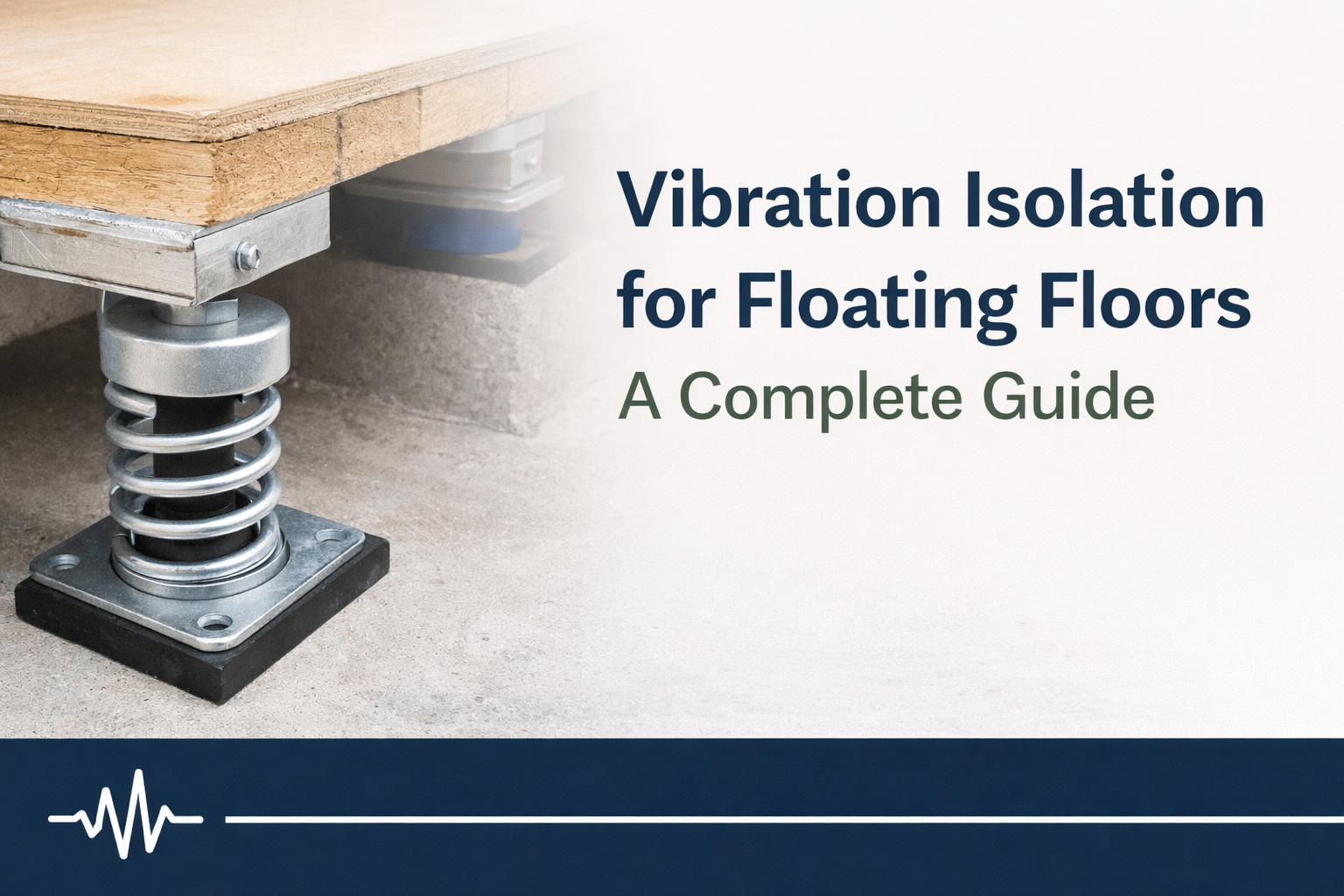
The VMF mount is a purpose-designed vibration isolation support for floating floor systems. It consists of a moulded neoprene or composite rubber element with a top plate for attachment to the floating deck and a base pad that sits on the structural slab. The element is engineered to achieve a defined static deflection under the floor’s dead load, placing the system’s natural frequency below the critical forcing frequencies of the application.
Key performance parameters of the VMF:
- Natural frequency: 7 to 12 Hz at rated load — well below the 50 Hz lower bound of significant impact noise energy
- Static deflection: 6 to 12 mm under dead load, maintaining isolation efficiency through the live load range
- Load capacity: available in multiple ratings to suit lightweight timber floating decks and heavy concrete floating slabs
- Point contact: the moulded element contacts the structural slab over a small area, minimising flanking transmission through the mount itself
- Height adjustment: available in adjustable-height configurations for level control over uneven slab surfaces
Where Floating Floor Isolation Is Used
Home Theatres
Home theatre spaces generate significant low-frequency energy from subwoofers and large-format speaker systems. Bass frequencies from 20 to 80 Hz propagate through the floor structure almost unimpeded by mass-based construction alone. A floating floor on VMF mounts places the system’s natural frequency below the lowest reproduced frequency, achieving isolation across the full cinema bass range.
The floating deck also prevents impact noise from the theatre space reaching rooms above or below — relevant in multi-storey residential installations where the theatre occupies a middle floor.
Recording Studios
Professional and semi-professional recording studios require acoustic separation from the surrounding building to prevent external noise entering the recorded signal and to prevent studio monitoring levels from disturbing adjacent occupants.
The room-within-a-room concept — floating floor, decoupled walls, and floating ceiling — relies on the floor isolation as its primary element. A poorly specified floating floor undermines the performance of the entire acoustic shell. VMF mounts engineered to the correct natural frequency for the dead load of the studio’s concrete floating slab are the standard specification for professional installations.
Multi-Family Residential
Impact noise is the most common source of neighbour complaints in apartment buildings and is the most difficult to address by remedial means after construction. Floating floor systems installed above structural slabs in residential buildings — particularly in high-end developments where noise criteria are stringent — provide impact noise improvement values (delta Lw) of 20 to 35 dB, far exceeding what resilient ceiling systems or soft floor coverings can achieve alone.
For multi-family residential, the specification challenge is achieving the required acoustic performance while maintaining acceptable floor-to-floor height. Low-profile VMF mounts in configurations with 30 to 50 mm finished assembly height allow floating floors to be incorporated without sacrificing ceiling height in the apartment below.
Floating Floor System Design
Dead Load Calculation
The VMF mount must be selected for the correct dead load. Under-load, the mount does not reach its rated deflection and the natural frequency rises above specification — degrading isolation performance. Over-load, the mount compresses beyond its linear range and stiffness increases — again degrading performance.
Calculate dead load per mount as: (floor deck mass + screed mass + finish mass) divided by mount spacing area. Mount spacing is typically 600 mm x 600 mm to 900 mm x 900 mm on a grid plan.
Natural Frequency Selection
Select the target natural frequency based on the lowest forcing frequency you need to isolate:
- Home theatre subwoofer systems (20 Hz and above): target 7 to 8 Hz natural frequency
- Recording studio monitoring (30 Hz and above): target 8 to 10 Hz natural frequency
- General residential impact noise (50 Hz and above): target 10 to 12 Hz natural frequency
Floating Deck Construction
The floating deck can be timber or concrete. Concrete floating slabs (75–100 mm depth) add significant dead load, which must be accounted for in mount selection, but provide excellent mass law performance and are standard in professional studio construction. Timber floating decks are lighter and suit residential applications where floor-to-floor height is constrained.
Perimeter Treatment
The floating deck must be fully decoupled from the surrounding wall structure. Any rigid contact between the deck edge and the wall — even a small bridging point — creates a flanking path that bypasses the isolation mounts and significantly degrades performance. Perimeter isolation strips of neoprene or polyethylene foam close the gap between deck and wall without creating a rigid contact.
Avoiding Common Floating Floor Failures
- Rigid bridging at perimeter: ensure a continuous gap between deck edge and all fixed walls — fill with compressible strip, not rigid mortar
- Pipe and conduit penetrations: all services penetrating the floating deck must use flexible connections — rigid pipe through the deck creates a vibration bridge
- Under-loading mounts at perimeter: perimeter mounts carry less dead load than field mounts — use lower-capacity mounts or adjust spacing at edges to maintain correct deflection
- Ignoring live load variation: a floating floor in a studio carries significant live load variation as people and equipment move — confirm the mount remains in its linear operating range across the full load range
- Concrete shrinkage cracking: concrete floating slabs must include adequate reinforcement and expansion provision — cracking that contacts the perimeter wall creates flanking
Performance Expectations
| Application | Target Delta Lw (Impact) | Typical Achieved |
| Residential (good) | 17 dB | 20 to 25 dB |
| Residential (premium) | 25 dB | 28 to 32 dB |
| Home theatre | 30 dB+ | 32 to 38 dB |
| Recording studio | 35 dB+ | 35 to 45 dB |
Specification and Supply
VMF mount selection requires confirmed dead load calculations, target natural frequency, and floating deck construction type. Submitting these parameters allows the correct mount variant and spacing to be confirmed against load-deflection test data rather than nominal ratings.
Vibro Limited supplies VMF floating floor mounts in timber and concrete deck configurations, with full product data sheets and installation guides available. Technical support for floating floor system design — including mount selection, spacing layouts, and perimeter isolation details — is available for specifying engineers and acoustic consultants.
Key Takeaways
- A floating floor isolates both impact noise and structure-borne airborne transmission — no other floor treatment achieves comparable performance
- VMF mounts must be selected for the correct dead load to achieve the rated natural frequency
- Target natural frequency depends on application: 7 to 8 Hz for home theatre, 10 to 12 Hz for residential
- Perimeter decoupling is as important as the mount specification — any rigid bridge defeats the system
- All service penetrations through the floating deck require flexible connections


