
Vibration Isolators In UAE for Industrial Sites
Heat, dust, and near-continuous machine operation put extra strain on isolation mounts across the region. Vibration Isolators In UAE installations need materials rated for those conditions specifically — a rubber compound designed for a temperate climate will harden and crack faster under sustained regional heat.
Plant rooms and rooftop equipment in particular need this consideration, since isolators mounted outdoors face direct sun exposure on top of the mechanical load they’re already carrying.
Sourcing Reliable Vibration Isolators In UAE
Local supply matters for lead times and post-installation support, especially on projects with tight commissioning schedules. Vibro stocks Vibration Isolators In UAE facilities can install quickly, sized correctly for regional plant and HVAC equipment from day one rather than waiting on imported parts mid-project.
FAQ
Does UAE heat really affect isolator lifespan?
Yes — sustained high temperatures accelerate degradation in standard rubber compounds, which is why heat-rated materials matter for outdoor or rooftop installs.
Can isolators be swapped without shutting down equipment?
Usually not fully — most installations require the equipment to be lifted or supported temporarily during isolator replacement.
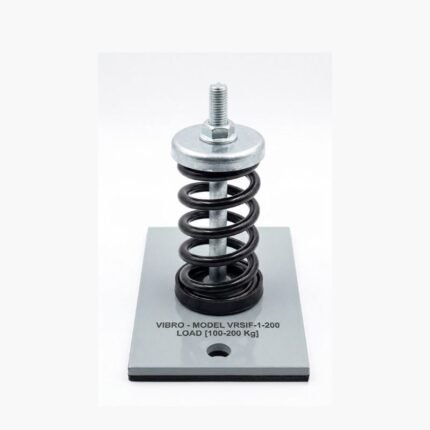
VIBRO ISOLATOR VRSIF
These high-deflection, free-standing spring isolators feature large-diameter, laterally stable steel coils that are unhoused and engineered for optimal performance. Each spring assembly is integrated into a robust upper load plate with a precision leveling mechanism to ensure consistent load distribution and ease of installation.
- Light-Duty Configuration: For lower load capacities, the isolators are equipped with molded neoprene bottom load plates, offering effective vibration damping and acoustic isolation.
- Heavy-Duty Configuration: For higher load applications, the steel springs are securely welded to a heavy-gauge steel bottom load plate. A neoprene isolation pad is bonded to this plate to enhance vibration attenuation and reduce structure-borne noise.
Technical Features and Performance Criteria:
-
- Spring Geometry: The ratio of spring diameter to compressed height under rated load is maintained at a minimum of 0.8, ensuring lateral stability and consistent performance.
- Corrosion Protection: Springs are finished with an epoxy powder coating, tested to withstand up to 1000 hours of salt spray exposure for enhanced durability in harsh environments.
- Acoustic Isolation: A neoprene friction pad is incorporated to act as a sound break, effectively minimizing the transmission of high-frequency vibrations.
- Vibration Isolation Efficiency: The system achieves a vibration isolation efficiency exceeding 95%, making it suitable for sensitive equipment and noise-critical installations.
- Structural Integration: Bottom plates are pre-engineered with bolt provisions to facilitate secure anchoring to the supporting structure.
- Stability Assurance: Lateral stiffness of the spring assembly is designed to exceed 1.0 times the rated vertical stiffness, ensuring reliable performance under dynamic loads.
- Overload Capacity: Each spring unit is rated to accommodate a minimum of 50% overload beyond its nominal load capacity. Springs are structurally safe even at solid height compression.
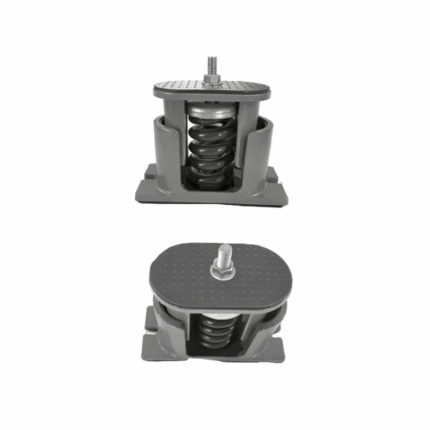
VIBRO ISOLATOR VRSIH
VRSIH Housed Spring Isolators are high-performance vibration control units designed to deliver substantial deflection while maintaining structural restraint. Each unit incorporates large-diameter, laterally stable steel springs housed within a fabricated steel enclosure to prevent excessive movement and ensure safe operation under dynamic, seismic, or wind-induced conditions.
The spring assembly sits between precision-engineered top and bottom load plates. The upper plate includes integrated leveling bolts, locknuts, and washers for accurate equipment alignment and secure attachment. The bottom plate features a non-skid neoprene isolation pad and bolt provisions for anchoring to the supporting structure.

VIBRO ISOLATOR VRSIR
How Equipment Vibration Isolators Protect Machinery
Pumps, chillers, and compressors shake the floor they sit on, and that motion travels further than most people expect. Equipment Vibration Isolators absorb this movement at the mounting point, protecting foundations and cutting noise transmitted through the building structure to floors and rooms nearby.
Without isolation, a rooftop chiller can become a low-frequency hum three floors down — not because the equipment is faulty, but because the mounting had nowhere else for the energy to go.
Selecting Equipment Vibration Isolators by Load
Spring or rubber-in-shear designs suit different weights and operating frequencies, and getting this wrong is the most common installation mistake. Matching Equipment Vibration Isolators to actual machine weight and RPM, rather than a generic size picked off a shelf, is what keeps mounted equipment stable long-term and prevents the isolator from bottoming out under load.
FAQ
What happens if an isolator is undersized?
It compresses too far, loses its isolating range, and effectively becomes a rigid connection — defeating its purpose.
Do isolators need replacing over time?
Rubber-based isolators degrade with age and heat exposure; springs last longer but should still be checked periodically for corrosion.


