

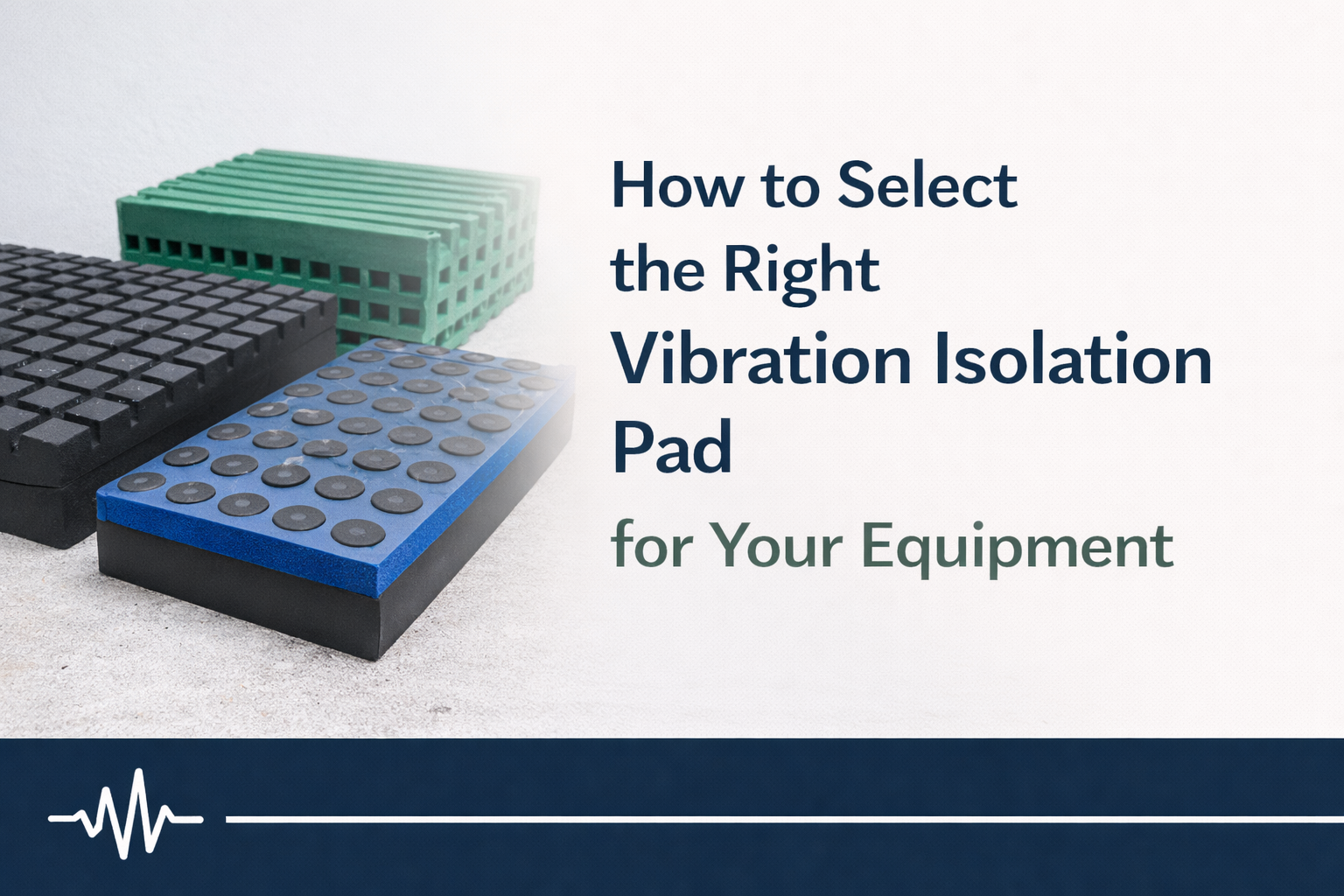
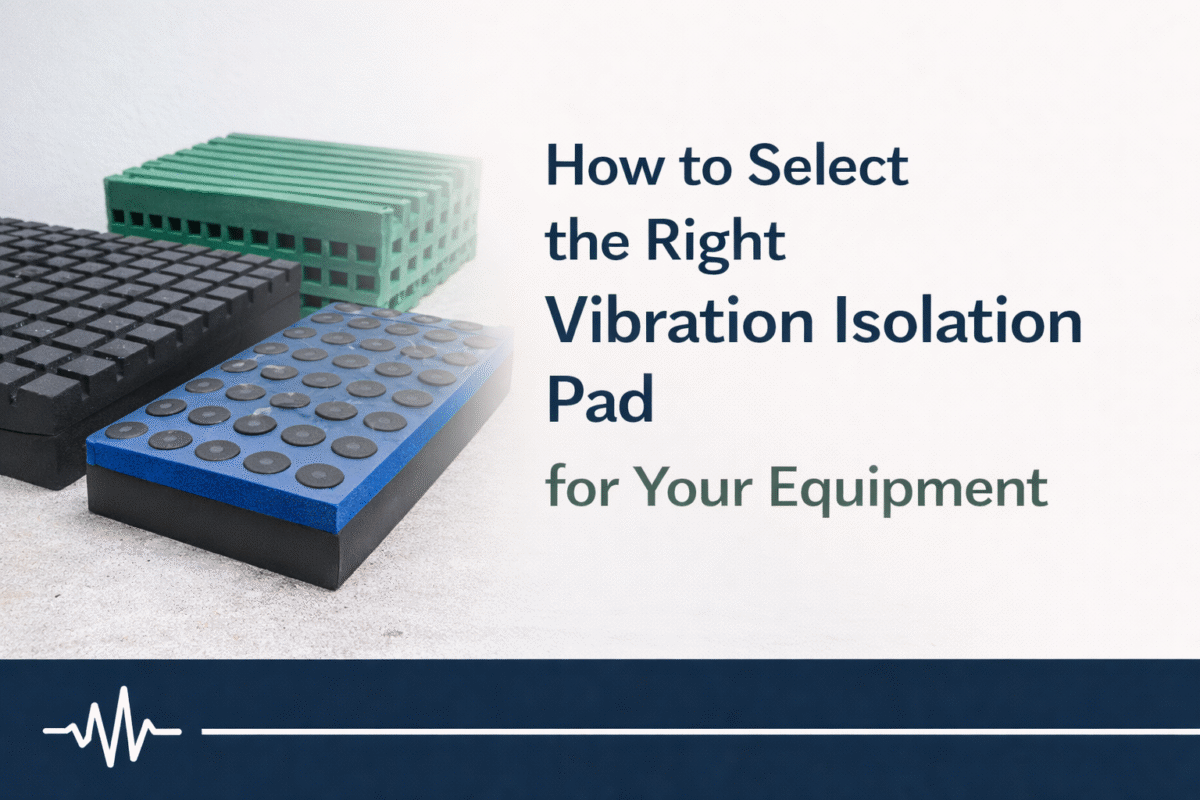
Vibration isolation pads are the simplest and most widely used vibration control product in mechanical plant. They sit under equipment, interrupt the vibration path to the structure, and cost a fraction of a spring isolator installation.
But a pad specified without regard to load, hardness, or application does not isolate — it simply acts as a rubber spacer. The wrong durometer, the wrong thickness, or the wrong product for the application and the pad compresses solid under load, achieving static deflection near zero and isolation efficiency close to nothing.
This guide covers the four core pad products — VRCP, VRNP, VRSP, and VRWP — how to select the right durometer for your load, and when stacking layers is the correct approach.
The Four Core Isolation Pad Products
VRCP — Ribbed Neoprene Pad
The VRCP is a moulded neoprene pad with a ribbed or waffle surface profile. The rib geometry is the key feature: ribs compress independently under load, allowing the effective stiffness of the pad to be significantly lower than a flat pad of the same hardness. This means a VRCP achieves greater static deflection per unit of hardness than any flat-profile neoprene product.
The VRCP is the standard specification for small to medium HVAC equipment: fan coil units, condensing units, small to mid-range pumps, and air handling units up to approximately 15 kW.
VRNP — Neoprene Levelling Pad
The VRNP is a flat-profile neoprene pad designed for use under inertia base frames, equipment rails, and machinery bases where a uniform bearing surface is required across the full contact area. Unlike the ribbed VRCP, the VRNP does not rely on geometric compliance for its deflection — the deflection comes from the bulk compression of the neoprene compound.
The VRNP is available in a range of durometer ratings (30 to 70 Shore A) matched to specific load-per-unit-area ranges. It is the correct product when load distribution uniformity matters more than maximising deflection.
VRSP — Neoprene and Steel Sandwich Pad
The VRSP bonds neoprene layers to steel plates in a sandwich construction. The steel plates constrain the lateral bulge of the neoprene under compressive load — a phenomenon called bulge factor — which significantly increases the effective stiffness of the rubber element compared to an unrestrained pad of the same compound.
This apparently counter-intuitive construction is specified for applications where the pad must carry very high loads in a small plan area without excessive lateral deformation. Heavy industrial machinery, press foundations, and generator sets on concrete plinths are typical applications.
VRWP — Wire Mesh Isolation Pad
The VRWP uses a compressed wire mesh — stainless steel or carbon steel — as its primary elastic element. Wire mesh pads offer a unique combination of properties: they tolerate high temperatures (up to 300 degrees C continuous), resist oils and solvents that degrade rubber compounds, and provide controlled damping that rubber pads cannot match.
Wire mesh pads are the correct specification for equipment in high-temperature environments, engine test cells, pump sets handling aggressive fluids, and applications where the mount is exposed to oils or hydraulic fluid.
Understanding Durometer Selection
Durometer — measured in Shore A — is the hardness of the elastomeric compound. It is the primary variable that determines a pad’s load capacity and deflection behaviour.
The fundamental relationship: a harder pad (higher Shore A) carries more load per unit area but deflects less. A softer pad (lower Shore A) achieves greater deflection but can be overloaded easily.
| Durometer (Shore A) | Load Range (kPa) | Typical Deflection | Best Application |
| 30 to 40 | 35 to 100 kPa | 4 to 6 mm | Light equipment, terminal units |
| 40 to 50 | 100 to 200 kPa | 3 to 5 mm | Medium HVAC plant, pumps |
| 50 to 60 | 200 to 350 kPa | 2 to 4 mm | Large pumps, AHUs, chillers |
| 60 to 70 | 350 to 600 kPa | 1.5 to 3 mm | Heavy machinery, generators |
To select the correct durometer: divide the equipment operating weight by the total pad bearing area. This gives you the load per unit area in kPa. Match this to the table above to identify the appropriate durometer range.
Critical rule: the pad must operate in the middle of its load range — not at the bottom (insufficient deflection from under-compression) and not at the top (risk of bottoming out and rigid contact).
How to Calculate Pad Load
Step 1: Determine equipment operating weight
Use the manufacturer’s operating weight — not dry weight or shipping weight. Operating weight includes all fluids (refrigerant, oil, water) and the weight of the motor.
Step 2: Determine number of mounting points
Count the support points: a unit with four corner feet has four mounting points. Divide total weight by number of mounting points to get weight per mount.
Step 3: Determine pad bearing area
The bearing area is the contact footprint of the pad. For a 100 mm x 100 mm pad, bearing area is 10,000 mm2. Divide weight per mount by bearing area to get load in kPa. For a 500 kg unit with four mounts, each mount carries 125 kg. On a 100 mm x 100 mm pad, load = (125 x 9.81) / 10,000 = 0.12 MPa = 120 kPa. This falls in the 40 to 50 Shore A range for a VRCP or VRNP pad.
Step 4: Check the deflection at that load
Confirm the pad achieves at least 2 mm deflection under the calculated load using the supplier’s load-deflection curve. Deflection below 1.5 mm provides marginal isolation benefit and may not justify the pad specification.
When to Stack Isolation Pad Layers
Stacking two or more pad layers in series reduces the system’s effective stiffness and increases deflection — effectively achieving a softer system without changing the pad compound. Stacking is the correct approach when:
- The available pad compound is too hard for the load but a softer compound is not available in the required configuration
- The application requires greater deflection than a single pad can achieve at the applied load — for example, isolating slow-speed rotating plant where neoprene deflection must approach 6 mm
- The installation height allows multiple layers and the lateral stability of the stack is acceptable
Important constraints on stacking:
- Do not stack more than three layers — a tall stack becomes laterally unstable under equipment vibration and can tip
- Separate stacked layers with steel plates to prevent inter-layer friction from increasing effective stiffness
- The total deflection of a stack in series is approximately the sum of individual layer deflections — confirm this against the load-deflection curves for each layer
- Stacking ribbed pads (VRCP) is not recommended — the rib geometry creates instability between layers
Product Selection Summary
| Product | Profile | Best For | Not Suitable For | Stackable? |
| VRCP | Ribbed neoprene | HVAC, pumps, FCUs | Heavy machinery | No |
| VRNP | Flat neoprene | Base frames, inertia bases | High-deflection needs | Yes (with plate) |
| VRSP | Sandwich neoprene-steel | Heavy machinery, high loads | Light equipment | Yes (with plate) |
| VRWP | Wire mesh | High temp, oil exposure | Precision levelling | Yes |
Common Mistakes in Pad Selection
- Using flat neoprene sheet cut from stock material — unrated stock sheet has no confirmed load-deflection data and provides unpredictable isolation
- Specifying the same pad for all equipment regardless of weight — a pad that works for a fan coil unit bottoms out under a chiller
- Ignoring the pad area — a large-area pad at low load-per-unit-area barely deflects; use a smaller pad or a softer compound
- Specifying rubber pads in high-temperature environments — neoprene above 100 degrees C degrades rapidly; use VRWP wire mesh pads
- Stacking ribbed pads — the rib geometry creates inter-layer instability under lateral vibration
Getting the Specification Right
Vibration isolation pad selection takes five minutes when you have the equipment weight, bearing area, and operating speed. Without these parameters, any pad selection is a guess.
Vibro Limited provides full load-deflection data for all VRCP, VRNP, VRSP, and VRWP products, with technical support for durometer selection and stacking configurations. Submitting equipment load data and application conditions allows the correct product and size to be confirmed against tested performance data — not nominal ratings.
Key Takeaways
- VRCP ribbed pads: standard specification for HVAC plant — the rib geometry maximises deflection at typical HVAC load levels
- VRNP flat pads: correct for inertia bases and equipment rails where uniform load distribution matters
- VRSP sandwich pads: specified for heavy machinery with high load per unit area in small bearing footprints
- VRWP wire mesh pads: correct for high temperature, oil-exposed, or high-damping applications
- Always calculate load per unit area and select durometer from load-deflection data — never specify by equipment type alone
- Stack VRNP or VRSP layers (with interleaved steel plates) to increase deflection when a single pad is insufficient


