

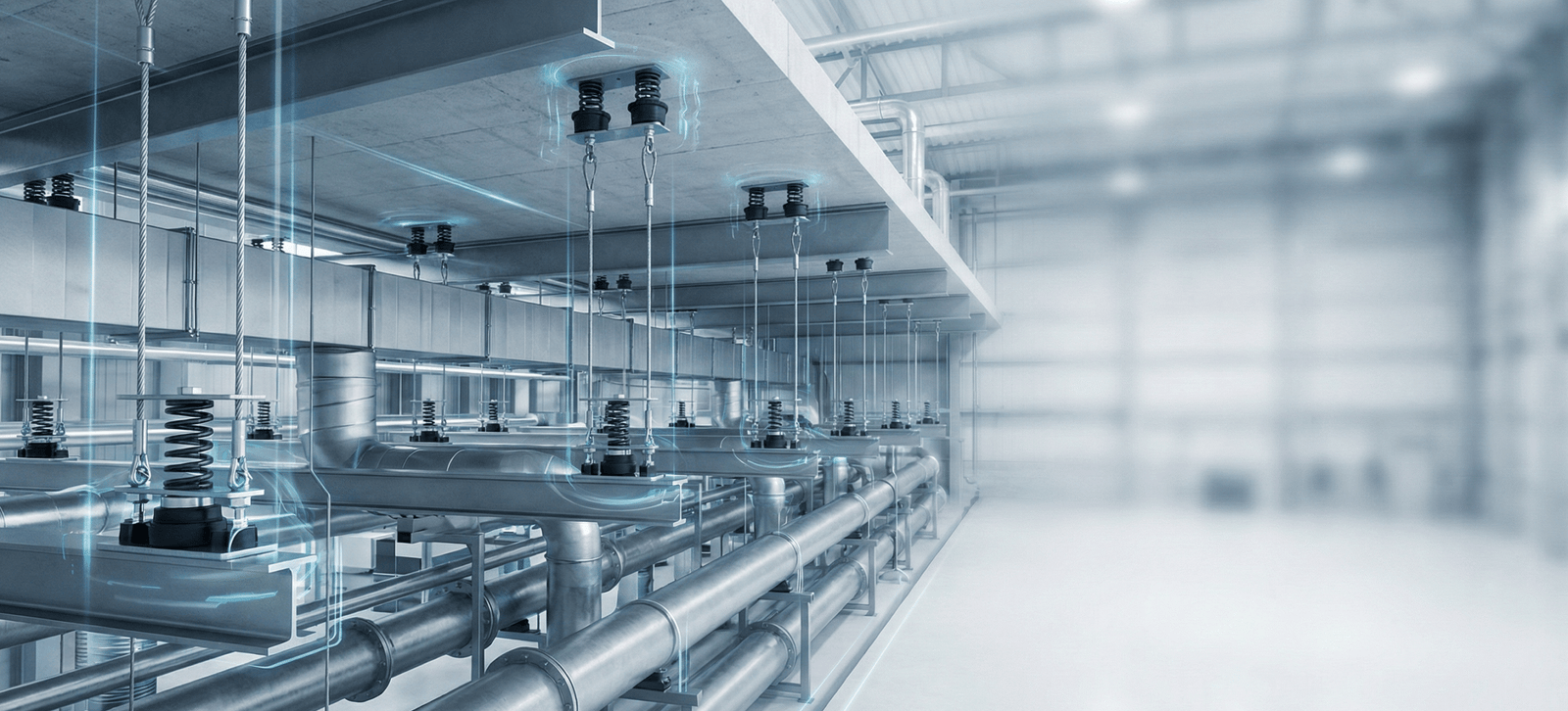
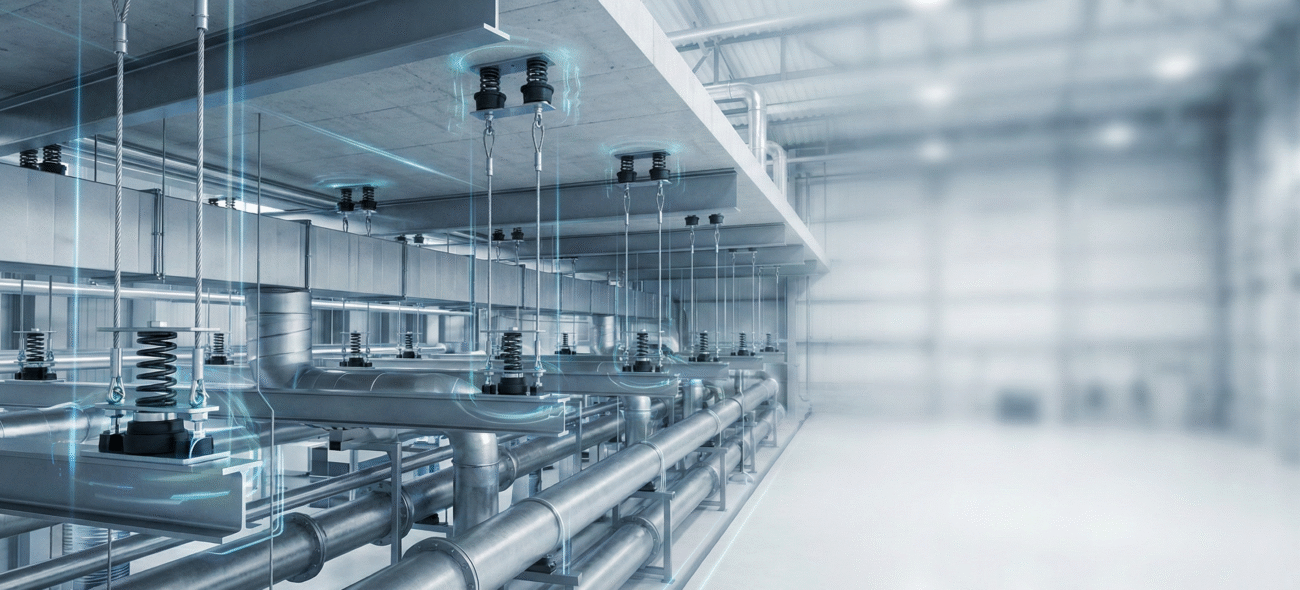
Mechanical systems are the heartbeat of modern buildings, but without proper vibration control, that heartbeat becomes a headache for occupants. Vibration isolation hangers represent a critical but often underspecified component in mechanical system design. As engineers, selecting the right vibration isolation hangers can mean the difference between a building that performs flawlessly and one plagued by noise complaints, premature equipment failure, and costly remediation.
Understanding Vibration Isolation Hangers and Their Function
Vibration isolation hangers are specialized support devices designed to suspend piping, ductwork, and mechanical equipment while preventing vibration transmission to the building structure. Unlike standard hangers that create a rigid connection, vibration isolation hangers incorporate resilient elements—typically springs, rubber, or neoprene—that absorb and dissipate vibration energy.
The physics are straightforward: when mechanical equipment operates, it generates vibrations. These vibrations travel through rigid connections into the building structure, where they amplify and radiate as structure-borne noise. By interrupting this transmission path with compliant isolation materials, vibration isolation hangers dramatically reduce both vibration and noise.
The isolator’s effectiveness depends on its natural frequency relative to the disturbing frequency. Optimal isolation occurs when the disturbing frequency is at least twice the isolator’s natural frequency. This relationship is fundamental to proper selection and explains why different applications require different isolator types.
Types of Vibration Isolation Hangers and Their Characteristics
Spring isolators represent the most common type of vibration isolation hanger. They use helical steel springs to provide isolation and support. Spring isolators excel at handling heavy loads and provide excellent low-frequency isolation, making them ideal for large pipes, major ductwork, and heavy equipment.
Spring isolators are available in various configurations including restrained and non-restrained versions. Restrained spring isolators limit vertical movement, important for systems where excessive displacement would cause alignment problems or stress on connected equipment.
Rubber and neoprene isolators offer a more compact solution with good performance at higher frequencies. These materials provide inherent damping that reduces resonance issues. However, they’re generally limited to lighter loads and may degrade over time, particularly in environments with temperature extremes or exposure to oils and chemicals.
Combination isolators integrate springs with elastomeric elements, offering benefits of both technologies. The spring provides low-frequency isolation and load capacity while the elastomer adds damping and high-frequency isolation. These versatile vibration isolation hangers suit a wide range of applications.
Acoustic hangers represent a specialized category designed specifically for noise-sensitive environments. They incorporate multiple isolation stages or specialized materials to achieve superior acoustic performance, though often at higher cost.
Critical Selection Criteria for Engineers
Load capacity is the foundational selection parameter. Calculate the actual load including pipe or duct weight, contents, and insulation. Add a safety factor of 25-50% to account for uncertainties and ensure the isolator operates in its optimal deflection range.
Deflection characteristics determine isolation performance. Greater static deflection generally provides better low-frequency isolation. A 1-inch deflection spring isolator typically achieves 90% isolation at frequencies above 10 Hz, while a 2-inch deflection unit extends effective isolation down to 7 Hz.
However, excessive deflection creates other problems. Large movements can misalign equipment, stress connections, and create clearance issues with surrounding structures. Balance isolation needs against practical constraints.
Operating frequency analysis is essential. Identify all vibration sources and their operating frequencies. Pumps typically generate vibration at their rotational speed and blade-pass frequencies. Fans add similar considerations. For variable speed equipment, consider the full operating range.
Environmental conditions influence material selection. Temperature extremes affect elastomeric materials—rubber hardens in cold, softens in heat. Chemical exposure from refrigerants, oils, or cleaning agents may degrade certain materials. Outdoor installations require weather-resistant construction.
Application-Specific Selection Guidelines
HVAC ductwork hangers require careful consideration of both weight and vibration characteristics. Main distribution ducts carry significant weight but relatively low vibration. Branch ducts near fans or air handlers experience higher vibration. Select vibration isolation hangers with deflection ratings appropriate to each situation.
For ductwork, spacing vibration isolation hangers every 10-12 feet typically provides adequate support while maintaining isolation effectiveness. Closer spacing may be needed near heavy equipment or at direction changes.
Piping systems present diverse requirements. Chilled water and condenser water pipes carry heavy loads with vibration primarily from pumps. Hot water and steam pipes add thermal expansion considerations. Refrigerant piping may see higher vibration levels from compressor pulsation.
Large diameter pipes (6 inches and above) typically use spring-type vibration isolation hangers for their superior load capacity. Smaller pipes may use rubber or combination isolators, particularly in noise-sensitive areas where compact size and high-frequency isolation are priorities.
Equipment mounting requires the highest isolation performance. Pumps, chillers, air handlers, and other rotating equipment generate significant vibration. Equipment platforms or bases suspended on vibration isolation hangers provide comprehensive isolation, but require careful engineering to ensure stability and proper alignment.
Common Mistakes and How to Avoid Them
Undersizing vibration isolation hangers is perhaps the most common error. When isolators carry more load than designed, they compress beyond their optimal operating range, reducing isolation effectiveness. Always verify actual loads including insulation, pipe contents, and any future additions.
Rigid bridges defeating isolation occur when piping or ductwork has rigid attachments too close to isolated sections. Maintain adequate flexible sections before the first rigid anchor. A common rule suggests at least 30 feet of flexible piping before rigidly anchoring to the structure.
Mismatched isolation at equipment connections creates problems. If equipment sits on spring isolators with 2-inch deflection but connected piping uses 1-inch deflection hangers, the differential movement creates stress and potential failure. Match deflection characteristics throughout the system.
Ignoring lateral restraint needs causes issues in seismic zones or with high-velocity fluids. While vibration isolation hangers allow vertical movement, uncontrolled lateral movement can damage systems. Incorporate snubbers or restraints where appropriate without creating rigid bypass paths for vibration.
Advanced Considerations for Complex Systems
Resonance analysis becomes critical in sophisticated installations. Every structure has natural frequencies where vibration amplifies dramatically. Identify these frequencies through analysis or testing and ensure isolator selection avoids exciting structural resonances.
Coupled systems require special attention. When multiple pieces of equipment connect through piping, vibrations from one can transmit to others. Analyze the system holistically rather than treating each component in isolation.
Seismic requirements complicate vibration isolation in earthquake-prone regions. Building codes often mandate restraints limiting movement during seismic events, which can compromise vibration isolation performance during normal operation. Specialized seismic vibration isolation hangers incorporate restraints that allow normal isolation while limiting earthquake displacement.
Installation Best Practices
Proper installation is as critical as proper selection. Ensure hangers are installed level and plumb. Cocked or misaligned vibration isolation hangers don’t perform as designed and may experience premature wear.
Pre-compressed springs require adjustment after installation. Most spring isolators ship with restraining bolts that hold the spring in a compressed state. After installation and system filling, remove these restraints to activate the isolation. Failure to remove restraining bolts is a surprisingly common error that completely negates the isolation.
Verify deflection after installation. Measure actual deflection under operating conditions and confirm it matches design expectations. Significant deviations indicate load miscalculations or installation errors requiring correction.
Performance Verification and Troubleshooting
Post-installation testing verifies system performance. Use vibration meters or accelerometers to measure vibration levels on isolated equipment and building structure. Effective isolation should show at least 70-80% reduction in vibration amplitude at the structure compared to the equipment.
If isolation performance disappoints, systematic troubleshooting identifies the cause. Check for rigid bypasses—electrical conduit, water pipes, or control wiring rigidly connecting isolated equipment to the structure. Even small rigid connections can significantly compromise isolation.
Verify isolator condition. Rubber elements may have hardened or degraded. Springs may have compressed beyond design limits due to overloading or corrosion.
Economic Considerations and ROI
Quality vibration isolation hangers cost more than standard hangers—sometimes 3-10 times more depending on type and capacity. This cost difference causes some value engineering attempts to reduce or eliminate isolation.
However, the costs of inadequate isolation far exceed the premium for proper vibration isolation hangers. Noise complaints may require expensive retrofit work. Structure-borne vibration can damage finishes, crack tiles, or cause equipment alignment problems. In commercial buildings, tenant dissatisfaction and turnover create substantial financial impact.
Consider lifecycle costs rather than just first costs. Properly selected and installed vibration isolation hangers typically last the life of the building with minimal maintenance. The investment pays dividends in occupant comfort, equipment longevity, and building performance.
Future Trends in Vibration Isolation
Smart vibration isolation hangers with integrated sensors represent an emerging technology. These devices monitor vibration levels and isolator condition in real-time, enabling predictive maintenance and performance optimization. While currently expensive, expect wider adoption as sensor costs decline.
Advanced materials including composite elastomers and specialty alloys improve performance and durability. These materials offer better temperature resistance, chemical resistance, and longer service life than traditional options.
Sustainability considerations are driving interest in recyclable and environmentally friendly isolator materials. Manufacturers are developing products with reduced environmental impact without compromising performance.
Making Informed Selections
Selecting the right vibration isolation hangers requires balancing multiple factors: load capacity, isolation performance, environmental conditions, cost constraints, and installation practicality. No single isolator type suits every application. Success comes from understanding the specific requirements of each system and matching them to appropriate isolator characteristics


