
Description
What Spring Isolators Do Under Heavy Equipment
Low-frequency vibration from large rotating equipment is difficult to control with rubber alone — it needs something with more give. Spring Isolators use a coiled steel spring to absorb that low-frequency motion, isolating chillers, pumps, and generators from the floor beneath them far more effectively than elastomer isolators on heavier loads.
The spring's deflection range is really the key figure here. A spring that compresses too little under load barely isolates anything; one properly matched to the equipment weight handles the job as intended.
Selecting Spring Isolators by Load and Frequency
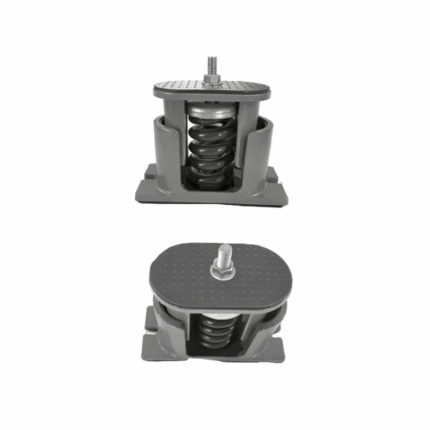
Spring Isolators are typically specified by load capacity and natural frequency rather than a single generic size, since a mismatch in either direction reduces effectiveness noticeably. Housed spring designs also protect against side-to-side movement on taller equipment, which open springs alone don't fully control.
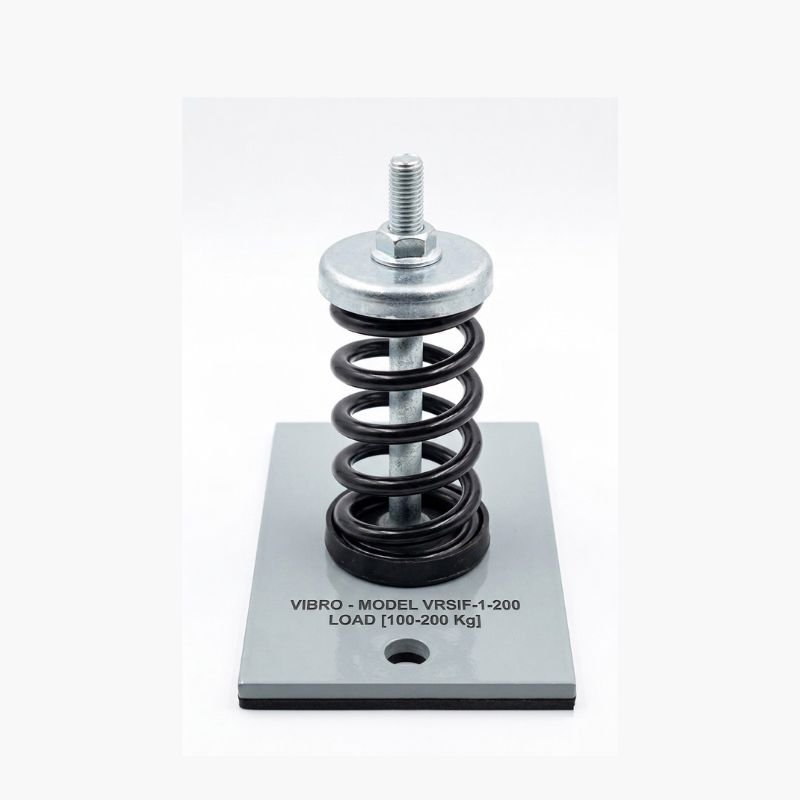
VRSIF shall consist of free-standing, large-diameter, laterally stable steel springs with a lateral stiffness greater than the rated vertical stiffness and designed to support a minimum overload capacity of 50%. Springs shall be assembled between top and bottom load plates, with the upper plate incorporating leveling bolts, locknuts, and washers for equipment attachment. Bottom plates shall include non-skid noise isolation pads and provisions for bolting to the supporting structure. Where required, isolators shall be housed in fabricated steel, with vertical restraints, neoprene snubbers, or internal pads to limit movement and prevent metal-to-metal contact. All housings shall be corrosion-resistant, either powder-coated, electro plated, or galvanized. Spring elements shall be powder-coated and rated for salt spray resistance when non-welded, and all springs shall be color-coded or otherwise marked for load identification. Springs shall be selected to provide the static deflections indicated in the Vibration Isolation Schedule or project documents.
- Rotary Equipment: Pumps, rotary wheels, and propeller-driven systems
- HVAC Systems: Packaged air handling units, air conditioning modules, and fan coil assemblies
- Fan Assemblies: Centrifugal and axial fans operating across varied speed ranges
- Compressors and Engines: Reciprocating chillers, air compressors, and internal combustion engines
These isolators are designed to accommodate the dynamic characteristics of each equipment type, ensuring stable support while effectively decoupling vibration energy from the building structure.
- Significant reduction in structure-borne noise and vibration
- Enhanced equipment performance and reduced mechanical wear
- Improved acoustic environment for sensitive installations
- Versatile application across a broad spectrum of mechanical system
FAQ
Are spring isolators better than rubber isolators for all equipment?
Not universally — springs excel with heavy, low-frequency vibration, while rubber isolators are often simpler and sufficient for lighter equipment.
Do spring isolators need periodic adjustment?
Some designs include leveling bolts that should be checked after initial settling, particularly in the weeks following installation.
Can spring isolators corrode over time?
Yes, especially in humid or coastal environments, which is why housed or coated spring options are often specified regionally.


